



By Daniel S. Burton and Alex Prong. Cover Graphic designed by Daniel S. Burton.
For the first time since 2020, The Brunswickan has selected and submitted an official awards nomination ballot for this year’s John H. McDonald (JHM) Awards for Excellence in Student Journalism.
Every February, the Canadian University Press (CUP) hosts and presents the prestigious JHM Awards at their annual student journalism conference, NASH. Student newspapers from across Canada send in nominations of the strongest and most impactful pieces they published over the past year (November 1–November 1). Then, a judging committee external to CUP selects a shortlist of 4–5 stories in each of the 21 categories.
On February 12–14, 2027, The Brunswickan will attend NASH89 at Concordia University in Montreal, Quebec. This marks our first shot at a finalist spot for a JHM Award since Alexandre Silberman was named a finalist in Indigenous Reporting and Data Journalism in 2020.
Arts and Culture Award
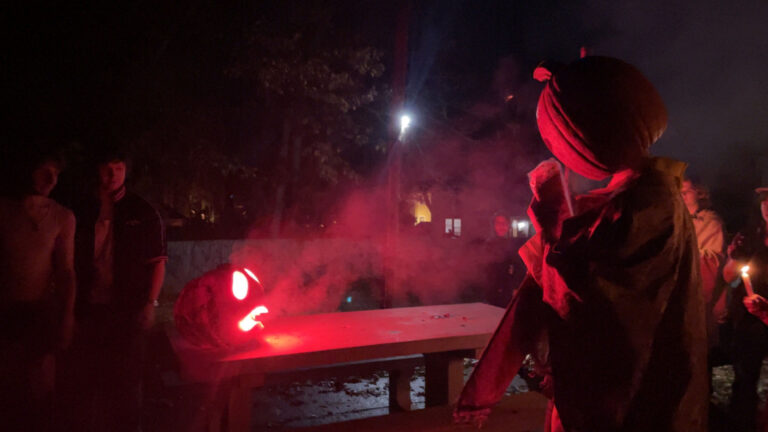
“The Great Pumpkin Sacrifice: New Beginnings or the End?” by Tiffany Parker, Grace Schramek, and Daniel S. Burton
The Great Pumpkin Sacrifice is a longtime tradition at UNB, and one The Brunswickan has similarly attempted to tackle for a long time, writing multiple stories from interviews to satires. “The Great Pumpkin Sacrifice: New Beginnings or the End?” is, as of this writing, the definitive Brunswickan investigation into the cultural history and connotations surrounding the pumpkin sacrifice. Growing from a single-reporter article into a collaborative investigative story, this piece features interviews with UNB students and a past Great Pumpkin Sacrifice eventrunner, archival research into KKK connotations, and feminist horror scholarship.
From the article: When considering these problematic practices and rumours alongside one another, an iconographic pattern begins to emerge, distorting what was intended as a celebration of new beginnings and academic success. This raises many questions worth considering: can we continue to celebrate this tradition in a way that acknowledges and moves past the harmful practices of its rumoured history? Can the spirit of Janus guide us toward a new beginning for the Great Pumpkin Sacrifice so that we might preserve one of UNB’s oldest and beloved traditions—or have we made our final sacrifice?
“Propaganda is Fine if it’s Funny: Memetic Warfare (featuring New Funswick)” by Ariel Lincoln
In her tenure at The Brunswickan, Ariel Lincoln spearheaded a well-received “Meme Review” column, including a few articles she wrote herself. “Propaganda is Fine if it’s Funny” is perhaps the ultimate entry. The article features an in-depth dive into the concept of memetic warfare and how politicians weaponize the internet, plus an interview about the emotional and political function of memes with Jason McIntyre of the popular New Funswick Instagram meme page.
From the article: The solution to memetic warfare and desensitization is not simple. In this digital economy, attention is currency and it’s becoming more difficult to disengage from social media. Though it may not feel like it, we have the agency to choose a life online or not. As McIntyre said, your attention does not need to be positive. Your outrage, polarization, and continual interaction is their goal. It’s time we recognize the harm in being passive consumers of their content and recognize who is really profiting off our emotions.
Bonus Arts and Culture Nomination
“Moncton Documentary Filmmaker Brings Physical Art to Light” by Tiffany Parker
The Brunswickan discovered Moncton documentary filmmaker Parker Barriault through his Instagram videos providing snippets from his documentaries across New Brunswick and Atlantic Canada. That first documentary we saw covered Spin-It Records, a nostalgic physical media shop. Tiffany Parker killed two birds with one stone, interviewing Barriault and Spin-It owner Patrick Perrise, discussing both the preservation of physical media and the ways modern content and independent documentaries can uplift creators and cultural touchstones of our past.
From the article: “My style’s not super polished, so it’s not, like, the most proper editing … It feels like it’s something that you can hold and feel that’s kind of raw … I just want my work to reflect how I see a place, how I experience or explore a place, and kind of reflect like a more personal experience … Anybody can spit the facts out, but finding those personal experiences … is what makes things like that special.” – Parker Barriault.
News Writing Award
“Invest in Us: NB Students Rally Against Proposed Funding Reduction” by Violet S.Z. Maier
The Brunswickan’s mandate is to provide timely news of interest to students in Fredericton, New Brunswick, and this article encapsulates our mandate perfectly. When the budget cut protests were ongoing in March 2026, it was all anyone was talking about at UNB, STU, and NBCCD. Violet was there at the heart of the protest, capturing the spirit of the event through recording speeches and directing pointed questions at the powers-that-be. This article speaks to a timely political issue that affects all students, and it speaks to this issue in a nuanced and accessible way. That is exactly what excellent student journalism is all about.
From the article: On March 17th 2026, over 1000 students from UNB, St. Thomas University, Mount Allison University, Université de Moncton, and NBCCD (New Brunswick College of Craft and Design) gathered at the Fredericton Legislative Assembly to protest the Holt administration’s proposed $35–50 million budget cut to post-secondary education. The protest occurred simultaneously with the administration’s decision on the final budget. The protest began at 10 a.m., lasting around five hours. UNB student Islay Hayward organized the event along with all the New Brunswick university student unions, except the UNBSU.
“UNB Professors Speak on the Trend of Defunding Universities” by Juhi Karkera
While Violet was covering the budget cuts story on the ground, Juhi was conducting detailed behind-the-scenes research into the history and broader socio-political implications of the cuts through interviews with UNB professors. She recorded pages and pages of transcripts, which she tirelessly wove together to create this story—a story which covers such points as anti-intellectualism, austerity measures, and the rise of fascism in Canada. Sometimes, “zooming out” into global issues can make a news piece feel ungrounded or aimless. But Juhi manages to keep this series of interviews close to the issue at hand: university budget cuts and the devastating impact these have on students, administrators, instructors, and the greater public.
From the article: “We have a kind of traditional patriarchal white nationalist society that fascist parties in Canada, the UK, and of course the United States, are defending. The university is seen as antithetical to their goals because we offer critiques of capitalism, racism, and white supremacy. These problems become a nasty cocktail for universities because what we have is essentially simultaneously austerity, neoliberal politics, and a fascist culture war against the kind of work that’s occurring in the universities. So yes, universities have come into the crosshairs of essentially all political parties.” – Dr. Nathan Kalman-Lamb
Feature Writing Award
This article features interviews with two prominent Indigenous mental health researchers, who are both transforming what it means to be academics. This is of particular importance given the fact that academic institutions’ authority over what counts as knowledge has historically been an arm of settler colonialism. Jill Williams and Raymond Jordan Johnson-Brown demonstrate the ways Indigenous researchers can navigate such institutions to bring about positive impact in Indigenous communities. The article highlights Mental Health Research in Canada (MHRC)’s calls for studentship applications, hoping to assist in getting more federal money into the hands of Indigenous students and communities.
From the article: “And so what I want to imagine is landing on the island, landing at my cabin. The smell of salt air. The sound of the water. We sew with grass, that’s another thing that Rigolet does. Imagine the smell and the sound of sewing grass. I see a kettle, an old black kettle on my woodstove, the only source of heat. It’s a one-room wooden cabin that my father-in-law and my husband built. I see that cabin with quilts my grandmother made around the cabin and the smell of tea and bread. And we sit and sew, and let conversation happen.” – Jill Williams
“Niko Stratis and Friends (Dad) Rock Out at the Fredericton Public Library” by Alex Prong
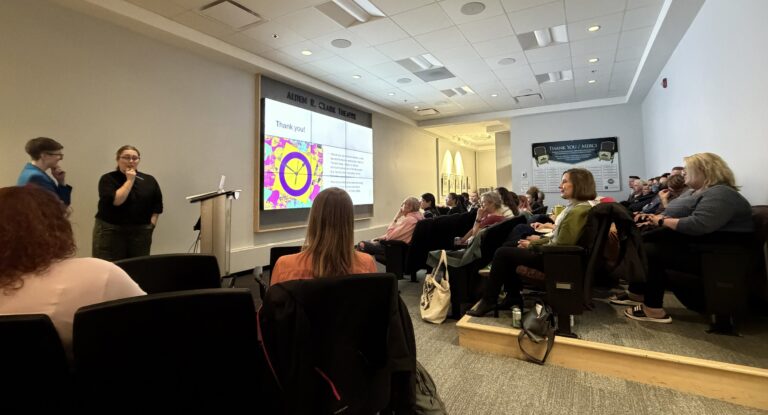
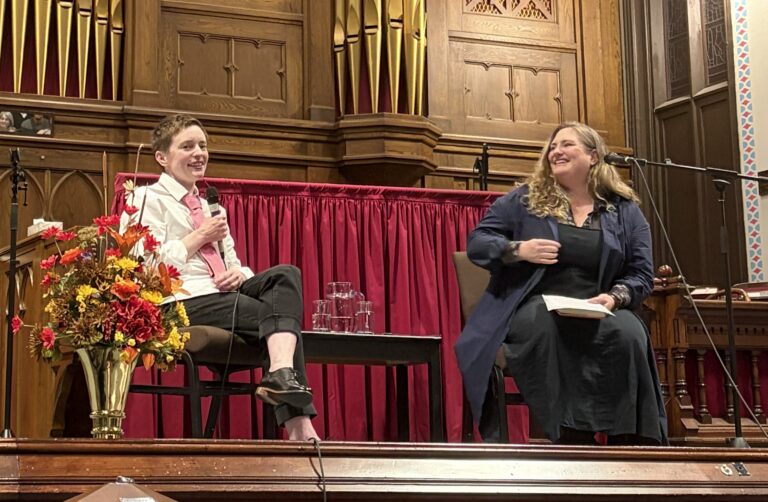
This recap of Niko Stratis’ stop in Fredericton on tour with her memoir-in-essays The Dad Rock That Made Me a Woman (2025) includes meditations on the similarities between dad rock and trans identity, a short playlist of songs from the book itself, and quotes from audience members. The strength of this article is that it conveys the trans themes in the book and evening without hammering the reader over the head, focusing on the ambiance and quotes from Stratis that give the reader a sense of having attended the event, even if they missed it.
From the article: She writes about drinking and dancing, which leads us into the last song of the night: “Dancing in the Dark” by Bruce Springsteen. Her chapter on this song is called “Want to change my clothes, my hair, my face,” and describes the trans meaning she found in this classic Americana tune. Relating the story of how Bruce Springsteen’s producer asked him to write another song for the album Born in the U.S.A. after he’d already written over sixty, Niko says that like Bruce, she knows what it means to be “just mad enough to make something beautiful.”
Opinion Writing Award
“A Message to My Father: Conversations on the Looming Inevitability of AI in Our Lives” by Grace Schramek
“A Message to My Father” is one of the first personal essays we’ve published in The Brunswickan in the past few years, and certainly the first to address such a large-scale issue as AI integration into workplaces and education and the intimate impact that can have on familial connections. “A Message to My Father” is an intelligent yet vulnerable piece that provides both a way to vent frustrations and illuminate larger harms, featuring real text conversations between Grace and her father. Blending philosophical thought and personal experience, Grace delivers a piece that elevates opinion writing into something intellectual, yet relatable, communal, and raw.
From the article: My father’s work is centered around understanding, developing, and educating companies on Artificial Intelligence. My work is founded on the desire to understand, develop, and communicate my Human Intelligence. As you might imagine, this has been the source of an ongoing discourse between the two of us for years.
“‘Spice Level?’: The Recent Rise of Romance, Romantasy, and Smut” by Juhi Karkera
Juhi’s “‘Spice Level?’” is a piece that delves beyond the proverbial BookTok comment section and into the roots of the rampant and deeply-rooted misunderstandings and distastes surrounding the romance genre. Juhi dives into the history of romance fiction and the shifting of female portrayal and sexuality in literature. Notably, she faces the distinction between romance and smut head on, and how the trope-ification of storytelling on social media and in the modern market has diluted the emotional connectivity of the romance genre.
From the article: [A]sking “Spice level?” is not inherently the issue. But when it becomes the primary and even sole metric of judging a piece of literature—sidelining world-building, character depth, and the moral/intent of the story—that is subversive. Romance deserves better. It has always been a genre of complexity, intimacy—not necessarily romantic—and emotional payoff, and readers deserve stories that deliver these instead of recycled tropes to keep up with the algorithm.
Sports Reporting Award
“Women’s AUS champions eye sixth national medal at Université Laval” by Bailey Young
UNB REDS sports, particularly women’s basketball, had one of the best years in recent history in 2025–2026. The Brunswickan’s 2025–2026 Sports Editor, Bailey Young, interviewed the UNB women’s basketball Head Coach Erin McAleen, along with player Clancy MacIntyre, AUS MVP and tournament all-star Katie Butts, and tournament all-star Kylee Speedy, following their February conference championship win. The coach and players discussed their tournament run, looked ahead to 2026 Nationals at Université Laval, and even touched on the sexism in sports conversation following President Donald Trump’s disrespect of the U.S. women’s hockey team at the 2026 Olympics.
From the article: “It is a huge honour,” McAleenan said on representing UNB on the national stage. “Our coaching staff is all from New Brunswick, so being able to represent the province on the national stage is very exciting. Specifically at Nationals, our focus is definitely to bring home a medal. UNB women’s basketball have won five national medals, so we are chasing the sixth.”
“Duel of the Hill: The Day of the Tournament” by Tiffany Parker
The Duel of the Hill was a mini-saga at The Brunswickan in September 2026. It started with Dhomas entering the Bruns office a few days before the residence-vs-residence fencing tournament, fired up and passionate about getting us involved. The Duel of the Hill’s tie to The Bruns dates back to 2010, where the editor-in-chiefs and sport editors from The Brunswickan and The Aquinian would duel. Tiffany attended a training session, interviewing Dhomas about the history of the event and UNB Fencing’s past struggles for a first installment to this saga, “Residence vs Residence: New Life for Historic Fencing Tournament at Lady Beaverbrook Gym.” The “Day of the Tournament” article features interviews and photos with participants of varying skill levels, right up to the winner, and a breakdown of the tournament.
From the article: After many different battles and great playing from all participants, the finale came down to Neville-Jones and Tibbits. Due to Neville-Jones’ Samuel Foulem being undefeated, the anonymous Tibbits resident would’ve had to beat him twice. Unfortunately, he wasn’t successful, and Samuel Foulem won undefeated, a flawless victory.
Marginalized Community Writing Award
“Trayces: An Exhibition of Black Identity and Lineage” by Juhi Karkera
Juhi’s “Trayces” article communicates the feeling of being in the room when Gary Weekes launched this powerful art exhibition without getting overly sentimental. Juhi describes the artwork, the inspiration for the artwork, and includes quotes that support the importance of Weekes’ work. She does so with a deft hand: rather than trying to explain for the marginalized community she is reporting on, namely Black New Brunswickers, she lets Weekes’ words and art, and the words of the community come through. This is the kind of platforming that helps marginalized groups have their voices heard.
From the article: As Joanne Owuor said in her speech at the opening ceremony, “Art becomes a human rights practice when it insists on presence, when it refuses erasure, and when it invites us to witness one another with care.”
“Indigo Alert: A Call to Protect the Vulnerable” by Tiffany Parker
This article serves the disabled community in two key ways: it describes at length the reasons why a missing disabled person might be in danger, and it presents an imperative for the reader to sign the petition to the Canadian government to create and implement the Indigo Alert. Using an impeccably-integrated interview with Indigo Alert advocate Chrystal Venator, Tiffany provides all the information a reader might need to understand the need for this new system. The article is concise, timely, and clearly communicated.
From the article: Currently, the National Public Alerting System announces when an individual is missing, physical characteristics, and any potential suspects. What they don’t express is the intellectual and developmental disabilities of the individual, and their capacity to communicate. In circumstances as dire and delicate as these, knowing the proper precautions to take when approaching someone could be a matter of life or death.
Humour Writing Award
“Compulsory Homosexuality: A Modest Proposal” by Alex Prong
The premise for this piece is Adrienne Rich’s notion of compulsory heterosexuality meets Jonathan Swift’s famous 1729 “A Modest Proposal” satirical essay. A lot of queer folks who realize they are queer later in life look about in anger at the millions of ways—media representation (or lack thereof), enforcement of binary gender, the wedding industry, blatant homophobia and transphobia, nature documentaries—that the world enforces heterosexuality as something that is natural, normal, and expected. Learning about compulsory heterosexuality can be a sick and twisted awakening, where you start to see it around every corner. Channeling that anger into comedy is one way of dealing with it, so this article flips the notion on its head.
From the article: Many Canadians still remember the historic day, back in 2005, when we legalized same-sex marriage. Some might see it as a weakness that Canada regulated and criminalized its citizens’ sexual activity for 101 years, but in light of this proposal, I pray we see it as a strength. Canada has successfully prescribed what a healthy, legal sexual relationship between two consenting adults can look like before. We can do it again.
Video of the Year
Everything Helps: An Expository Documentary by Nathan Crowley-Peters, Violet S.Z. Maier, and Dawa Penjor
Everything Helps: An Expository Documentary is an investigative look into the student demonstrations in support of Palestinian Solidarity that took place on Canadian University campuses, how the universities administrations responded, and the subsequent impacts. Everything Helps is The Bruns’ first documentary, outgrowing its original mini-documentary length at an exceptional 33 minutes. Director Nathan Crowley-Peters, along with Director of Photography Violet Maier and Camera Assistant Dawa Penjor, interviewed numerous professors and students across different universities including UNB and U of T, traveled to Moncton to interview retired UNBSJ professor and protester Jeff Houlahan, repeatedly sought interviews with UNB Security, and pushed through many challenges to create this documentary. This brave and impactful work created a piece that both informs and inspires viewers to research, support, and act for Palestinian Solidarity. The documentary is published on the Brunswickan YouTube, @BrunswickanVideo.
From the documentary: “All of these things… You know, one of the guys that we protest with on Saturdays … when we talk about this he says ‘Everything helps.’ And so, everything helps.” – Jeff Houlahan
Photo of the Year
“Storytelling and advocacy at the Voice of the People rally” by Nathan Crowley-Peters
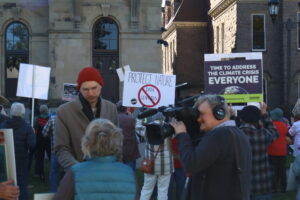
Nathan took this photo for his October 24, 2026 story “Voice of the People Rally.” The photo evokes the sense of inquiry, communication, and passion at the Voice of the People rally, from video interviews to protest signs.
“2026 Poetry Weekend Presiding Spirit Jamie Kitts’ electric speech” by Huy Vo
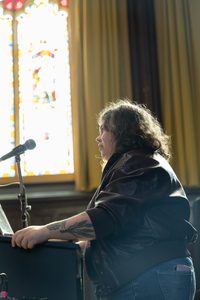
The Brunswickan’s 2026–2027 Photographer Huy Vo captured a plethora of thoughtful and specific photos at Poetry Weekend 2026. “2026 Poetry Weekend Presiding Spirit Jamie Kitts’ electric speech” captures the passionate ending of the event led by writer and UNB PhD student Jamie Kitts’ powerful final speech, imploring the audience to help protect trans and queer rights across Canada. This photo appears in Alex Prong’s “Poetry Weekend 2026: 73 Poets, One Unforgettable Weekend.”
Bonus Photo of the Year Nomination
“EDUCATION IS OUR FUTURE” by Violet S.Z. Maier
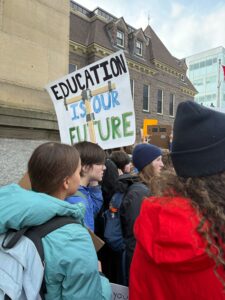
“EDUCATION IS OUR FUTURE” captures the perspective of being out in the centre of the crowd at the March 17, 2026 protest at the Legislative Assembly Building. The photo depicts the vast group of young people gathered together in protest of the Holt administration’s proposed educational budget cuts, representing the passion and drive to action of New Brunswick’s youth in contrast to the proposed cuts against their development. This photo appears in Violet S.Z. Maiers’ article “Invest in Us: NB Students Protest Proposed Funding Reductions.”
Graphic / Visual of the Year
“Charlotte Brontë and her copy of ‘A Court of Thorns and Roses’” by Mason Tozer
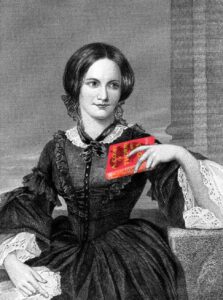
Truly excellent graphics can communicate the thesis of a story in a single glance, and that’s what this image does. “Charlotte Brontë and her copy of ‘A Court of Thorns and Roses’” depicts a black-and-white image of famed author Charlotte Brontë reading an in-colour copy of the contemporary smut-romantasy book A Court of Thorns and Roses by Sarah J. Maas. The article this graphic accompanies is an opinion piece on the rising popularity of smut to the detriment of plot and character development. Forgive the brief dive into ironic internet speak, but this image basically communicates “RIP Charlotte Brontë, you would have loved ACOTAR.” Not to mention Mason’s eye for design in keeping the Brontë image black-and-white and the book its signature eye-catching coral red cover. This dichotomous framing communicates the contrast between Brontë’s historical highbrow contribution to romance and ACOTAR’s connotations with the declining public opinion surrounding literariness in romance. Simply put: this picture says a thousand words. This graphic appears in Juhi Karkera’s article “‘Spice Level?’: The Recent Rise of Romance, Romantasy, and Smut” in the February 2026 ‘Doom’-entines edition.
“Compulsory Homosexuality Graphic” by Mason Tozer
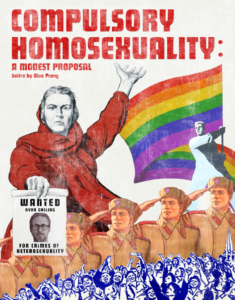
There is no better way to complement a wildly satirical article than with a wildly satirical graphic. Mason took the prompt of pro-homosexual propaganda and made it his own, coming up with this vibrant and comic take on what if Russian propagandists were gay and mad at Ryan Gosling. Little details, like the upside down triangles on the soldiers hats, really make the graphic special and fun to look at. The font choice for the title, and texturizing of the piece as a whole to make it feel like a worn poster really sell the final product. Look out for this one at next year’s student poster sale! This graphic appears in Alex Prong’s “Compulsory Homosexuality: A Modest Proposal” in the April 2026 Sun’s Out Bruns Out edition.
Cover / Layout of the Year
‘Doom’-entines by Dawa Penjor

Dawa’s ‘Doom’-entines design splices modern technology with classical paintings, sculptures, and artworks reminiscient of normative Valentine’s Day iconography. He uses a modern juvenille sticker style to highlight how this edition plays with the conventions of Valentine’s Day, crossing over into Doomer culture, and trying to find yourself and your fascinations in the middle ground between the idealistic past and pessimistic futures of relationships, romance, and self-love.
Student Journalist of the Year (Written)
Tiffany Parker
Tiffany started at The Brunswickan in February 2026 with a passion to learn and share her thoughts through writing. Tiffany has extended herself into almost every corner of student journalism: arts and culture (including both current events and historical context), news, interviews with bands and musical groups, reviews, opinion pieces, marginalized representation pieces, and sports coverage. Through each foray into new journalistic territory, Tiffany has entered with curiosity, vulnerability, and an openness to feedback and editorial collaboration. Taking every story as an opportunity to learn and refine her craft, Tiffany has demonstrated an ability to carry new writing and communication skills forward into future projects.
Addressing her position at The Brunswickan, Tiffany says:
“Writing has always been a huge passion of mine and a way for me to convey how I feel, so being given the honor to share my work with others is something I’m very grateful for!”
We at The Brunswickan look forward to more stories and collaborations to come.
Student Journalist of the Year (Multi-Media)
Nathan Crowley-Peters
Nathan has taken on a variety of multi-media projects since starting at The Brunswickan, and all of them bring a fresh feel to reporting. Though print stories aren’t going anywhere, Nathan’s videos offer a way of engaging with news that feels personal, engaging, and immediate. Nathan has also been a key contributor to The Brunswickan’s photography seen in various print and online articles over the Fall 2026 semester. He is involved and consistently attending events for photo and video content, even outside of his own stories.
In addition to his written stories, Nathan spearheaded The Brunswickan’s first major documentary, Everything Helps: An Expository Documentary, which helped revive The Brunswickan’s YouTube channel.
Speaking to the power of storytelling in mixed media, Nathan says:
“What I appreciate about mixed-media stories is the opportunity to present the same story in multiple mediums. It enables the creator of the media to expand their reach across different audiences, and can provide the audience different interpretations of the same story.”
Nathan’s willingness to jump into the fray and curiosity to follow leads are strengths that make him a vital part of this year’s team at The Brunswickan.
That does it for our nominations and this blast through our biggest hits in the JHM Award-recognized categories from the 2025-2026 awards season. The Brunswickan thanks all of our incredible staff (past and present), other contributors, and all our readers for undergoing this journey with us over the past year. We couldn’t even be in the running without you.
CUP will announce the shortlist of finalists in each category in January 2027, and will reveal the winners on February 13, 2027 during NASH89.