



By Tiffany Parker, Grace Schramek, and Daniel S. Burton
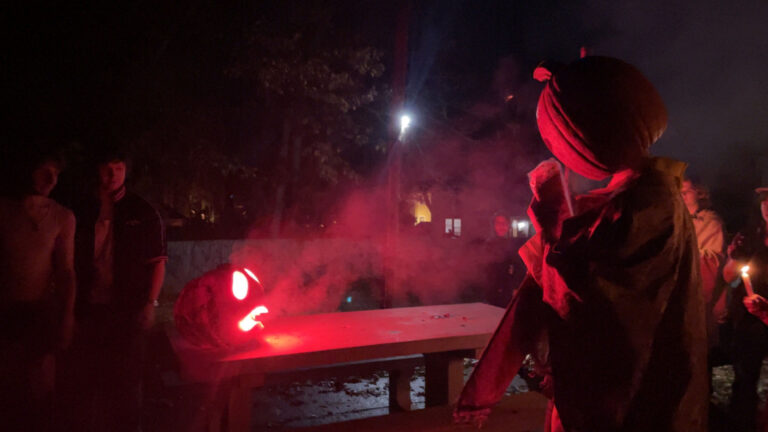
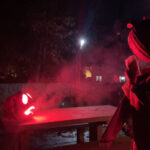
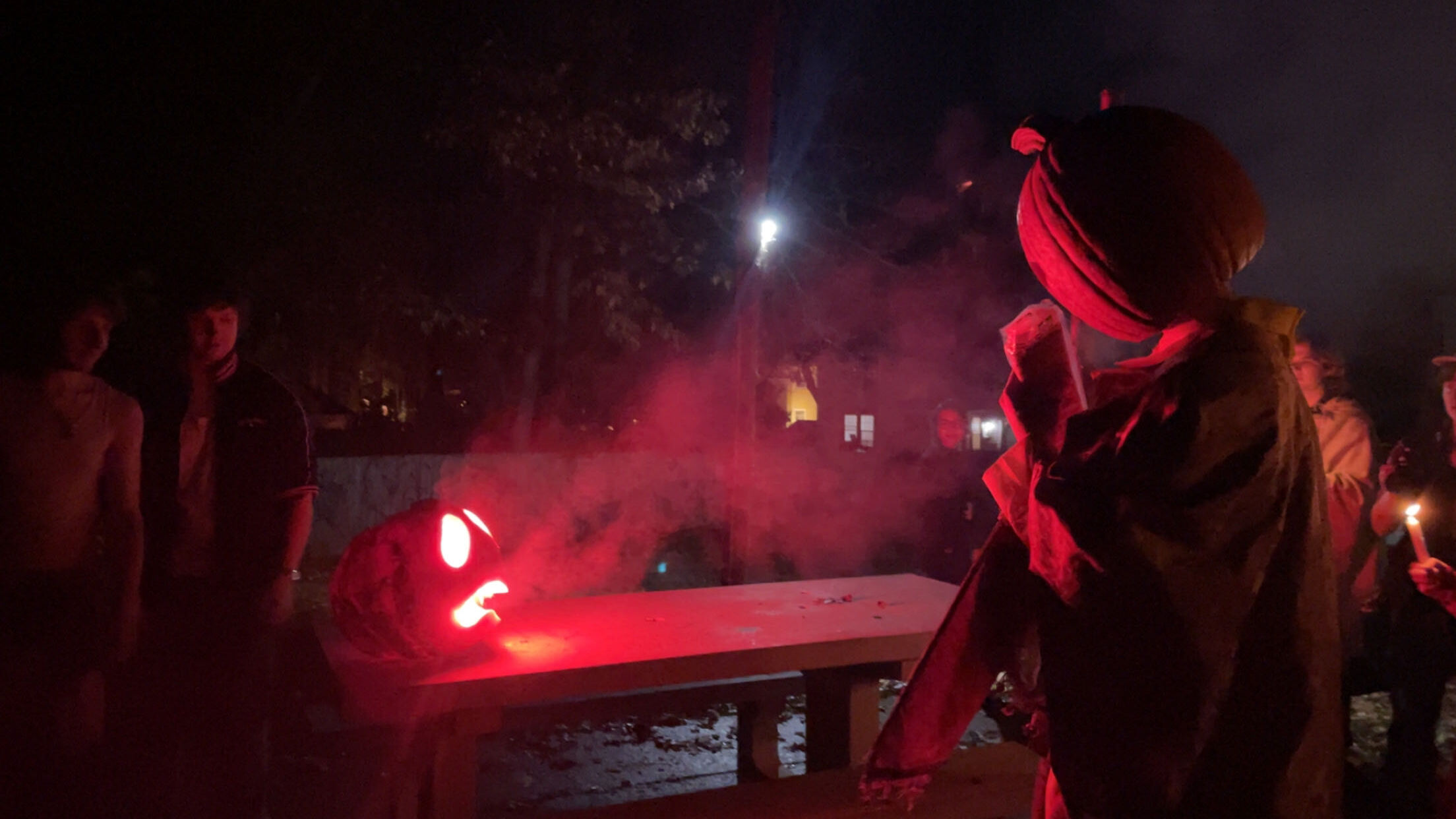
Cover Photo: Off-campus Pumpkin Sacrifice, October 31, 2024. Photo Credit: Keianna Borden
Introduction
Harrison House’s Great Pumpkin Sacrifice is one of UNB’s oldest traditions (starting 1973), though as of 2022, UNB Residence Life coordinators have banned the event from campus. Following the shutdown, students have begun piecing together some unsettling connotations surrounding the sacrifice, resulting in a series of realizations and rumours across campus. Administrative staff and Harrison residence assistants have refused to comment on the matter this year, as well as during last year (2025)’s Brunswickan investigation.
Despite the last in-house ritual occurring in October 2021, the Great Pumpkin Sacrifice’s legacy lives on. In 2024, UNB students held a revival of the event at Fredericton’s infamous walking bridge, and again at an off-campus house in 2025. During Res Life’s interference in 2022, Harrison House alumni Patrick Richard posted a petition to keep the tradition going, which although having closed unsuccessfully, has ignited a passion in the hearts of involved Harrison House residents.
While investigating some of the rumours surrounding the Great Pumpkin Sacrifice, underlying themes of ignorance began to reveal themselves, leading us to wonder if there is truth behind ongoing rumors, and whether or not this tradition can continue.
Humble Origins
In 1973, three drunken students who accidentally dropped a pumpkin off the Harrison House roof on Halloween night gave rise to the long-lasting tradition.
Every Halloween, Harrison House residents would carve a pumpkin with two faces to resemble the Roman god Janus, the god of new beginnings, gates, and transitions. With one face looking to the past, and one toward the future, Janus symbolizes the transition between the two states. The face looking to the past represents students’ hope to leave early-year failures or tribulations behind, while the face looking to the future represents good luck and academic performance to come. Students would carry out the ritual in the name of the “academic harvest,” sacrificing the pumpkin to ward off a “bad crop” of grades. Students would drop the pumpkin at midnight from the third floor of the House while performing Gregorian chants and prayers.
Unsavoury Rumours: Robes, Injuries, and the Virgin Girl Sacrifice
Hooded Figures
However beloved it may be, this lively tradition is riddled with dark undertones. Students have begun to circulate rumours rooted in the ritual’s potentially harmful connotations. The most prominent was an association with the Ku Klux Klan (KKK). While the KKK originated in the United States, their violence spread to Canada, with evidence of these communities in New Brunswick existing in provincial archives. Some photos from the annual Pumpkin Sacrifices (including 1975 and 1987) depict students wearing white hooded robes—a trademark of the KKK—which raised concerns within the community.
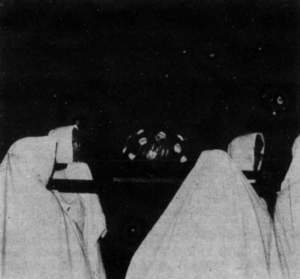
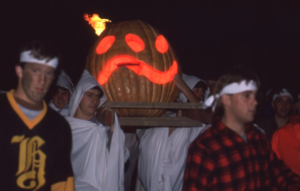
The 2024/25 Great Pumpkin Sacrifice eventrunner (anonymity requested) shared their interpretation:
“That is not part of the meaning; [for] the people who founded it, that’s not what they wanted it to be either. I mean, you’re sacrificing the pumpkin for academic success and blessing the plentiful harvest. KKK is just kind of looking for extra meaning that’s not actually there…”
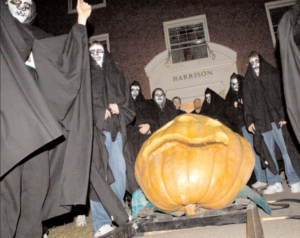
Participants in more recent years have opted for a more tasteful costume of black (evidenced in the 2005 Sacrifice; see image below) or brown robes (2024 and 2025 sacrifices, according to the eventrunner). The eventrunner stated that they “don’t think it could continue without the costumes.” However, they also mentioned that “it’s important to change as society changes to be accepting of everybody, and I feel like that’s what we did.”
Safety Risks
Yet another controversy behind this event was a rumored injury that took place. TJ Patey, a fourth year psychology major at UNBF, acknowledged that he too has heard the rumors of the racial implications of the white robes, as well as an injury that resulted from one of the ceremonies. He recalled what he heard:
“Many residents were talking about this injury and many wanted to continue the tradition, but due to many concerns from residents, including the risk of injury, they had to stop. They had different alternatives, but the House Committee wanted to do something, so they smashed [the pumpkin] with a sledgehammer instead [of throwing it from the third floor].”
Although the injury itself is not confirmed, throwing a pumpkin from a residence’s upper floors or roof is a safety hazard, and it is important to acknowledge its potential severity.
The Virgin Girl Sacrifice
The final rumor is the alleged sacrificing of a virgin girl as part of the Great Pumpkin Sacrifice. The “virgin girl sacrifice” is not documented in any published account of the Great Pumpkin Sacrifice, leading us to believe it is a relatively new addition to the event. In 2019, The Brunswickan published a satire article describing the “killing of a virgin student” replacing the pumpkin in the sacrifice. There is no confirmation of when the virgin sacrifice first became part of the Great Pumpkin Sacrifice lore, though it is interesting to note that this satire proves the concept has been circulating as of at least 2019.
An anonymous third-year UNB student shared what they have heard regarding the practices surrounding the “virgin girl”:
“[Harrison residents] would dress up in white hoods or cloaks and then they would kick a resident, typically a freshman, out of their dorm for the day on the top floor as they would take [the pumpkin] over and do the sacrifice through that window. Then, somewhere a virgin girl from Joy Kidd falls into place—I’m now thinking it might be her who lights the flare—so they have a flare light inside the giant pumpkin—and then they take it up the stairs hoisting it on a platform, chanting something, and then they throw it out that resident’s window…”
The eventrunner shared their interpretation of the virgin girl sacrifice:
“[Historically an] all-boys house, the Harrison House [guys] would walk to Lady Dunn [now Joy Kidd House] and they would ‘steal a girl,’ and they agreed to it before and they want to do it; it’s kind of a representation of—I can’t remember what it represents but I don’t remember having any opinion on it that was negative as it’s not really harming anybody … Yeah I don’t think that’s controversial in my brain, but people are pretty sensitive with everything these days that you could offend somebody by walking down the street wrong.”
The line between oversensitivity and insensitivity can be quite fine, and often entirely subjective. Even if the intentions of the tradition are not malicious (as our eventrunner has expressed), the iconographic significance of the “virgin girl” has deep cultural roots.
Virginity, particularly that of young women, is a common theme within the horror genre, appearing most recognizably during the slasher boom of the late 70s and 80s. In her foundational essay “Her body, himself: gender in the slasher film,” Carol J. Clover notes that “in the slasher film, sexual transgressors of both sexes are scheduled for early destruction” (199).
In slashers, the “final girl,” is the one to survive the massacre and conquer the killer, and is typically the girl in the cast who maintains her “innocence” (her virginity) by the end of the story. (See Halloween, Friday the 13th, etc.) Julia Chiappe’s Berkley Fiction Review article “Final Girl Theory” addresses how “male-directed media tends to fixate on the female character’s sexual status and how it affects her ‘purity’ as a victim…” Further, she points out that because many slasher films are catered to the male gaze, the female victim is typically sexualized while, paradoxically, simultaneously portrayed as “innocent or sexually inexperienced.”
Perhaps the most significant depiction of the virgin girl sacrifice in contemporary pop-culture is Jennifer’s Body (2009). Jennifer’s Body centres Jennifer Check, a non-virgin mean girl, having a cult boy band attempt to sacrifice her as a virgin to Satan, causing it to backfire and winding up with her possessed, going on a man-eating killing spree. In her thesis book, Hell is a Teenage Girl: Whiteness, Shame, and Gothic Girlhoods in Popular Culture, Dr. Krysta Fitzpatrick discusses Jennifer’s Body under the lens of abject or deadly adolescent women. Jennifer’s Body in fact plays with the satirization of the virgin girl sacrifice in a subversive mode; though even as a self-aware project, the line between empowerment and unconscious abjection is blurry.
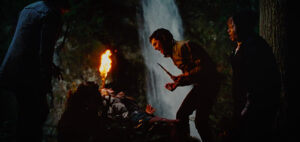
Despite the intention of Jennifer’s Body and other satirical girl-boss-esque horrors to destabilize patriarchal violence through matriarchal subversions, “they fail to avoid the patriarchal tropes of the male gaze and female monstrosity … and most research fails to acknowledge the misogynistic undertones within the films which reinforce patriarchal beliefs to the audience” (Fitzpatrick ix–x). When wielding these tropes even satirically, practitioners are handling concepts largely misunderstood which often subtextually or unconsciously harken the history the tropes are rooted in.
The thematic core of the Great Pumpkin Sacrifice (a sacrifice for a better semester) echoes Fitzpatrick’s concept of adolescent horror, simultaneously reinforcing and combating the Gothic Girlhood theme that “no girl gets through adolescence unscathed” (ix). Here, this is extendable to Gothic (late) adolescence at large, the University becoming the place of both challenge and the solution of interpersonal connection. Perhaps the inability to emerge unscathed in the context of the Sacrifice becomes the basis for the connection and event (though in this reading the virgin sacrifice still doesn’t fit neatly into the event’s mission).
Wall Street Journal Editor-in-Chief Sarah Ball questions the inherent pitfalls baked into such supposedly subversive use of tropes in her 2009 Newsweek article “‘Jennifer’s Body’: Why Hollywood Apparently Can’t Make a Feminist Slasher Movie.” Ball asks a question indicative not just of the undertones of these films, but of any play or satirization with patriarchal devices: “Can we joke about sex and violence without getting egg on our faces─without reinforcing the conceits we intend to subvert?” If intentional use of these devices (such as the virgin sacrifice) have historically lost their footing, consider how haphazard inclusions may undermine the jokes and practices which they’re intended to elevate.
Taking all of this into consideration, it is important to note that the virgin girl sacrifice was not included in the 2024/25 renditions of the event, according to the eventrunner and another anonymous participant.
The investigation of this peculiar phenomenon also led us to question the very relevance of the “virgin girl,” finding it to be potentially both redundant and contradictory.
If the pumpkin (Janus) is a symbol for new beginnings, what does the virgin girl represent, if anything? If the two are analogous, why double up on the symbol, and if we wish to invite new beginnings, why harken a symbol rooted in gendered conceptions of the past? Moreover, if we sacrifice the pumpkin for the sake of the “academic harvest,” to what type of god or entity are we sacrificing it? And are we sacrificing the virgin to the same god? These questions remain unanswered.
Community and Culture
The 2024/25 eventrunner gave their final thoughts on the situation:
“I think that having house spirit can be a really positive experience with you and all your other residents, and traditions can kind of bring people together if they’re fun, but if you’re stripping that stuff away, people stop talking to each other … I feel like the new dorms were kind of designed for people to not talk to each other, so yeah I definitely think that traditions are super important to bring people together.”
They had further mentioned a journal containing accounts of the sacrifice in previous years, that has since mysteriously disappeared. It is possible that the disappearance of the journal was due to someone simply losing or accidentally discarding it, though with the silence surrounding the Sacrifice and the eventrunner’s idea that the “school” got rid of it, it may have also been deliberately removed. As of now, the truth remains undeterminable.
When considering these problematic practices and rumours alongside one another, an iconographic pattern begins to emerge, distorting what was intended as a celebration of new beginnings and academic success. This raises many questions worth considering: can we continue to celebrate this tradition in a way that acknowledges and moves past the harmful practices of its rumoured history? Can the spirit of Janus guide us toward a new beginning for the Great Pumpkin Sacrifice so that we might preserve one of UNB’s oldest and beloved traditions—or have we made our final sacrifice?