



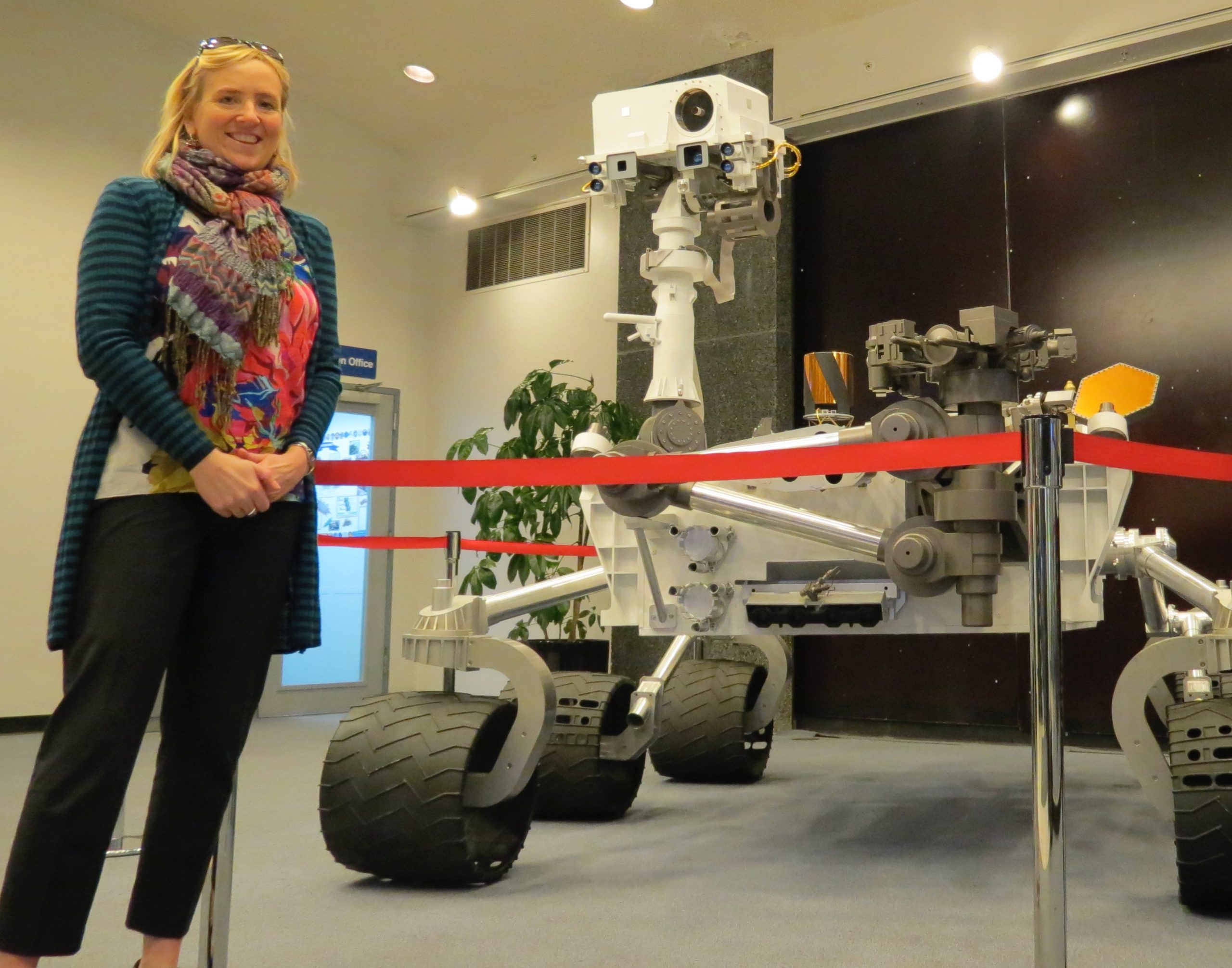
From collecting rocks as a toddler to studying them at age 13 and deciding she wanted to be a geologist, UNB graduate Lucy Thompson never thought she’d be working on a key instrument for the Mars rover.
“I just decided that I wanted to be a geologist and I’ve never looked back,” said Thompson. “Basically, I love it.”
She studied as a graduate student at UNB with Dr. John Spray, the director of the Planetary and Space Science Centre. He was recommended by the Canadian Space Agency to be a part of the Curiosity rover project and because of Thompson’s work with Spray, she began her involvement with the project when the rover launched in November of 2011.
Thompson’s work contributed to the Alpha Particle X-Ray Spectrometer (APXS), a Canadian built instrument installed on the Curiosity rover. The APXS is on the end of a robotic arm so Thompson and her team frequently collaborate with engineers at the NASA Jet Propulsion Laboratory (JPL) in Pasadena, California to carefully manoeuvre the instrument to analyze rocks, sand, soil or specific points in the atmosphere.
Catherine O’Connell-Cooper started working on the project with Spray and Thompson in 2005, near the end of her graduate degree when the project expanded to include need for a second geologist.
“I was in the right place at the right time,” she said.
The team is comprised partially of permanent residents such as O’Connell-Cooper who is originally from Ireland and Thompson, who is from the UK.
In the Planetary and Space Sciences Centre, their expertise is in impact cratering—Mars is riddled with impact craters. One of these craters, named Gale, has been home to the Curiosity rover since it landed on Mars.
The Curiosity rover, using the APXS, will study soil, rocks and the local geological setting to test the possible habitability of Mars. Curiosity’s job is to assess whether or not Mars may have the proper environment to support tiny life forms, or microbes.
For the beginning of the mission, Thompson was in Los Angeles at the Jet Propulsion Laboratory (JPL) working on Martian time. A Mars day is 40 minutes longer than an Earth day which accumulates overtime.
“You end up getting completely out of sync. Some of the Mars shifts we did during those first 90 days were in the middle of the night,” Thompson said. “I didn’t know what I was signing up for.”
Despite 2:00am shifts and 10:00pm meetings, she still found the experience to be fun and still tells O’Connell-Cooper stories about her time in Pasadena at the JPL.
O’Connell-Cooper understands how work as a geologist can be seen as boring, or dismissed as simply rocks. The excitement comes when you realize that it’s more than that—they’re Martian rocks.
“You look up in the sky and you can see Mars in the sky. And you think, that’s where our rover is, it’s up there,” she said.
Her other favourite part about her job is never knowing what she’s going to find when looking at her rocks.
“Everyone’s always looking for the thing that’s different. Everybody gets excited,” O’Connell-Cooper said. “But even when they’re not different, even when they fit in, we can see a pattern, we can see continuity, and we can come up with the story about this because its following what we thought it would.”