



Physicists from the University of New Brunswick are leading the development of communication technology that will help the Government of Canada monitor activity in the Arctic.
David Themens, a former UNB physics student, and professor P.T. Jayachandran are leading the development of one of Canada’s latest defence technologies: the Empirical High-Arctic Ionospheric Model.
The ionosphere is part of the Earth’s atmosphere, sitting at an altitude of roughly 80 to 100 km. It consists of atmosphere ionized by radiation and can be used to reflect high-frequency radio waves, thus boosting communications signals. This is where the Empirical Model comes in.
The model, part of the first phase of a $1.2-million contract with Defence Research and Development Canada, shows the current status of the ionosphere in the Canadian high-Arctic. While the ionosphere is used to boost radio signals by bouncing them distances they would not otherwise be able to reach, the ionosphere is affected by both regular weather and space or solar weather – meaning this much-needed frequency boost is often unpredictable in its efficacy and availability.
“The ionosphere is cool,” Themens said. “It’s affected by the atmosphere below it and the interplanetary medium beyond the Earth’s magnetic field. Large clouds of plasma from the sun bring with them strong magnetic fields – depending on the orientation of the plasma, it can be sucked in or deflected.”
When plasma from the sun is sucked into the Earth’s atmosphere, it affects the ionosphere and thus the Empirical Model. One way in which this is visible to the naked eye is with the aurora borealis, or northern lights.
The model of the ionosphere was originally Themens’ doctorate work, but he and his colleagues were contracted by Defence Research and Development Canada to make a working model.
The model maps out the ionosphere so it can be better used and monitored. Because of recent developments in technology, the ionosphere can be used to reflect radar as well as regular radio waves. This has an interesting application for the Canadian government when it comes to national defence.
Sea ice in the Canadian arctic has been melting faster and faster every year. This means that the northwest passage is open to more and more shipping traffic for more extended periods of time. Not all of this traffic is wanted or legal, and as the border in the north grows, it is becoming increasingly difficult to monitor who travels through Canadian waters.
The Empirical Model being developed by Themens and Jayachandran would allow the government to use radar more effectively so that shipping traffic and activity could be better monitored and controlled.
“We’re trying to keep up with climate change in the arctic,” Themens said. “We never thought that we would have to protect this border that is now fairly accessible… especially to shipping traffic.”
The model is fairly complicated as it attempts to map an ever-changing atmospheric landscape. Themens explained that while the ionosphere is a mirror, it’s not necessarily a very good one. This means that disturbances in the ionosphere can affect the use of long-range radio and radar – as well as early missile and weather warning systems – and can even go so far as to affect actual flight traffic.
However, the model takes in information from both atmospheric and solar weather phenomena and inputs it so that governments and private interests will be able to adjust their data accordingly and use their radar and radio systems even while the ionosphere is being disturbed by weather.
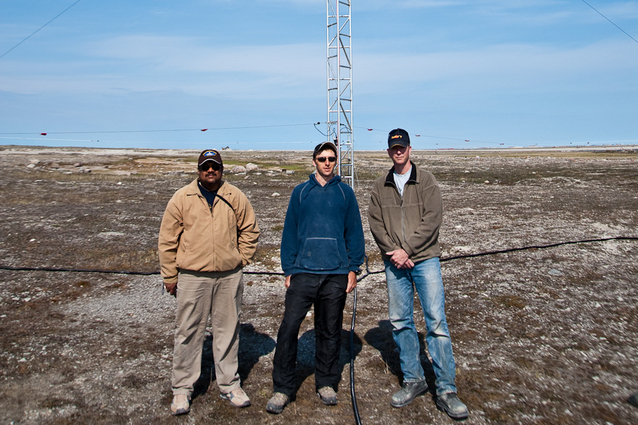
Recently, part of the high-Arctic research team was in Hall Beach, Nunavut, installing monitor towers. What began as Themens’ doctorate research has become a national project spanning multiple provinces and territories.
While Themens noted he “couldn’t speculate as to government uses” of the model, the project is considered fairly significant for a country trying to protect and monitor a border that grows larger with each melting cycle.