



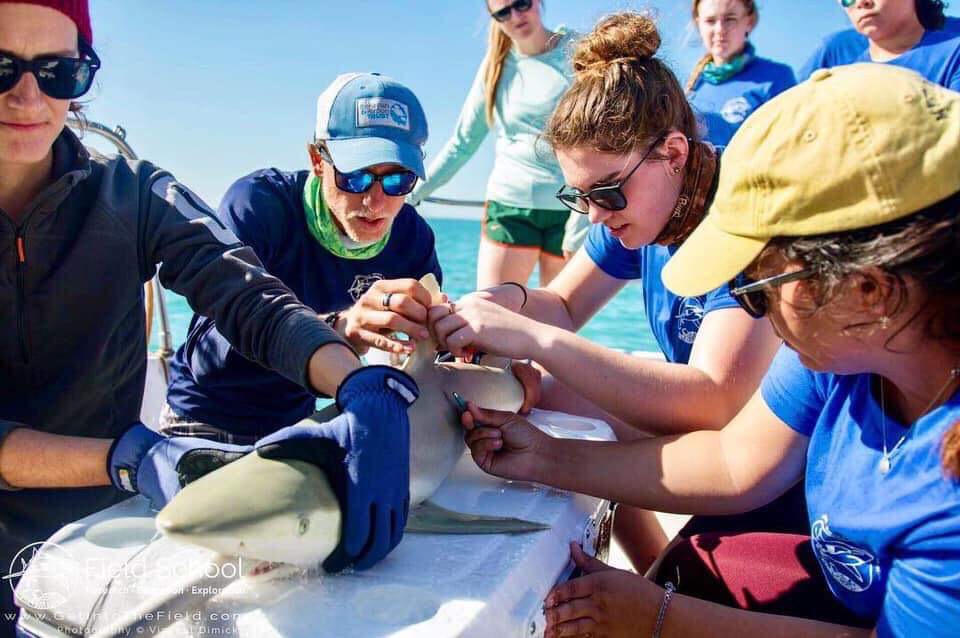
Second-year biology student Reid Sutherland was awarded a Field School Scholarship to participate in a shark tagging project in Miami, Florida.
Sutherland, who is the logistics chair of Girls STEM Up, an Irving-sponsored conference aimed at encouraging young women to become involved in the sectors of science and technology, was the youngest student involved in the tagging program.
“There were some master’s candidates there, as well as some graduating from their bachelor’s which was a little intimidating, but still fun,” Sutherland said.
The program in Miami was very intensive. Sutherland spent her days free-diving and working with the sharks, and her nights cleaning equipment and preparing for the next day. She also had the opportunity to attend lectures, and was taught safe procedures for interacting with the animals and working out at sea.
“We learned a variety of nautical knots for different purposes – knowledge that we exercised daily when tying bullet floats and other buoys to mariner’s rope for shark fishing sets.”
After working day and night alongside researchers who had over 40 years of experience with sharks, Sutherland quickly developed a personal relationship with her research subjects.
“I got to swim through a school of fish, and even with some barracuda,” she said. She described encountering a nursing shark (an elusive, but rather docile species) while snorkelling, and though many might find it terrifying to see a shark while swimming, Sutherland described it as “pretty fun.”
“The sharks were incredible,” Sutherland said. “We got to interact with a variety of them, from huge nurse sharks to little sharpnoses. We also got to examine two yellow rays and see an eagle ray breach.”
The project itself focused on short-term elasmobranch research (research on fishes with cartilage, such as rays and sharks). Sutherland and her work group examined physiological traits of the sharks, took blood samples and tagged animals.
She also had the opportunity to learn how to work with the sharks and rays without causing them undue stress. “The research being conducted on these sharks can tell scientists a variety of important things such as migration, reproductive, and feeding patterns, species richness and abundance,” said Sutherland.
She went on to explain that the data collected on the various species would serve not only to measure overall health and wellness of different shark species, but will be used to measure how sharks are being impacted by human influences such as climate change.
Research conducted by Dalhousie University and the University of Windsor shows that global shark populations are in decline due to overfishing and habitat loss, with much of that habitat loss caused by ocean warming and pollution.
The research with which Sutherland was involved aims to measure the impact of those factors so humans can learn to minimize and reverse the damage caused to some of the ocean’s most well-known inhabitants.
“The reason that the work we do matters is that the entire oceanic ecosystem would collapse with the loss of its [sharks]…. Sharks need our protection,” Sutherland said.
While films like Jaws make sharks out to be villains, Sutherland recognizes them as victims. “They are suffering at the hands of human greed, and their home… is becoming increasingly polluted with micro plastics, hydrocarbons, and chemicals. As a result, oceans are becoming acidified and sharks are still being overfished – creating a grim future for the sea and its inhabitants.”