



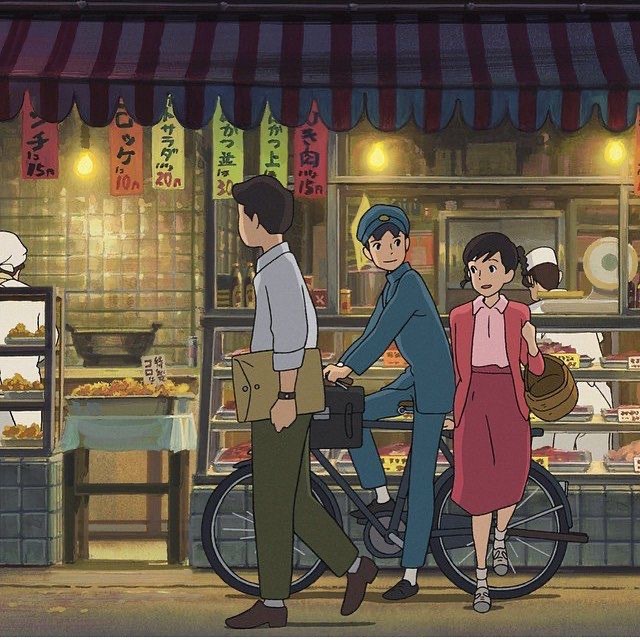
Directed by Gorō Miyazaki, son of Hayao Miyazaki, From Up on Poppy Hill may actually be one of the best films ever produced by Studio Ghibli, and it is definitely the best film the younger Miyazaki has directed yet.
The 2011 animated film follows Umi Matsuzaki, a highschool student who helps run her grandmother’s boarding house while her mother finishes her university studies in America. The film takes place in the early 1960s as Japan rebuilds, prepares for the Olympics, and tries to forget the horrors of the Second World War.
Umi seems to the audience a no-nonsense girl. She basically runs the boarding house, looks after her siblings, and keeps very good grades in school. Her routine is set: raise her flags, cook breakfast, get to school. But her routine is quickly challenged as she discovers someone on a boat in the harbour has been answering her signals and published a poem to her in the school’s student newspaper. Beyond this, the Quartier Latin, a giant building that houses the school’s wildest clubs, is being demolished to make way for a new building. The boys who value the building for its history hold a number of demonstrations and disruptions, and soon Umi is drawn into the conflict.
But it’s not just the dark academia romance of the Quartier Latin that gets Umi involved. It’s Shun Kazama, who helps run the school newspaper. As they work to save the old building from demolition, the two fall in love. But there is a major conflict – and this is what makes the film interesting.
Aristotle is the one who created the modern definition of a tragedy. Most commonly people understand this definition as requiring the main character to be someone of great importance who suffers from hubris, undergoes a reversal, and dies at the end. However, Aristotle discussed another form of tragedy, one that he said was actually his favourite – a tragedy where there is a happy ending. In this form of tragedy, the protagonist comes to the final moment of realization and makes the correct decision to rectify the situation, instead of giving in to fate.
Gorō Miyazaki’s film is the most perfect example of this second type of tragedy. The romantic plot is perfectly Greek. It could have appeared in the Dionysia.
Shun and Umi discover that they are siblings. Shun comes over to Umi’s house, and she shows him a photo of her father, who was killed in the Korean War, and two of his friends from the army. Shun recognizes the photo, as he was given exactly the same one by his father after being told he was adopted. The man in the photo is the man his adopted father told him was his biological father. Shun and Umi decide that while they love each other, they can never act on their feelings.
However, through a complicated series of events after they save the Quartier Latin, they speak to Umi’s mother, who reveals that Shun is actually the son of her husband’s close friend. Shun’s mother died in childbirth, and his father was killed in the war, so Umi’s father adopted him so he wouldn’t go to an orphanage. However, when he realized they couldn’t afford to support both Umi and Shun, he took Shun to a close friend of the family who had just lost a baby. Shun and Umi manage to track down the last living man from Shun and Umi’s photograph – their father’s former commander. Through him, they learn that the second man in the photograph is Shun’s real father, and that they are most definitely not related.
The story brings the intense, beautiful romance to the brink of destruction, and then scales it back. It’s a tragedy as tragic as Aristotle would ever have wanted. It’s not only a beautiful story of two young people whose lives are impacted by war, as the plotline following the Quartier Latin as it is almost demolished is a story about how Japan moved forward after the Second World War and the Korean War. It’s about the beauty of progress and history merging together to create something unprecedented and special.
If you never watch another Studio Ghibli movie, you should watch this one. It is an Aristotelian masterpiece. It’s a story more about Japan than about anything else. It’s a story about love – past, present, future.