



Taking Notes on Paper
Most people still write notes in the good old fashion way, by pen and paper. If you are one of them, it is key that you organize your notes.
– REVIEW, RETYPE, and REVISE your notes into a computer document at a later time. Revising your notes will not only make them easier to find, but repeatedly rewriting them will help you memorize the most important points in your notes. If you don’t use a computer at all, re-writing by hand will also help you with memorization.
– Try creating specially timed intervals whereby you will continue to revise your notes into smaller and smaller bits, a method of studying called spaced repetition. Pomodoro is very similar.
Taking Notes on a Tablet
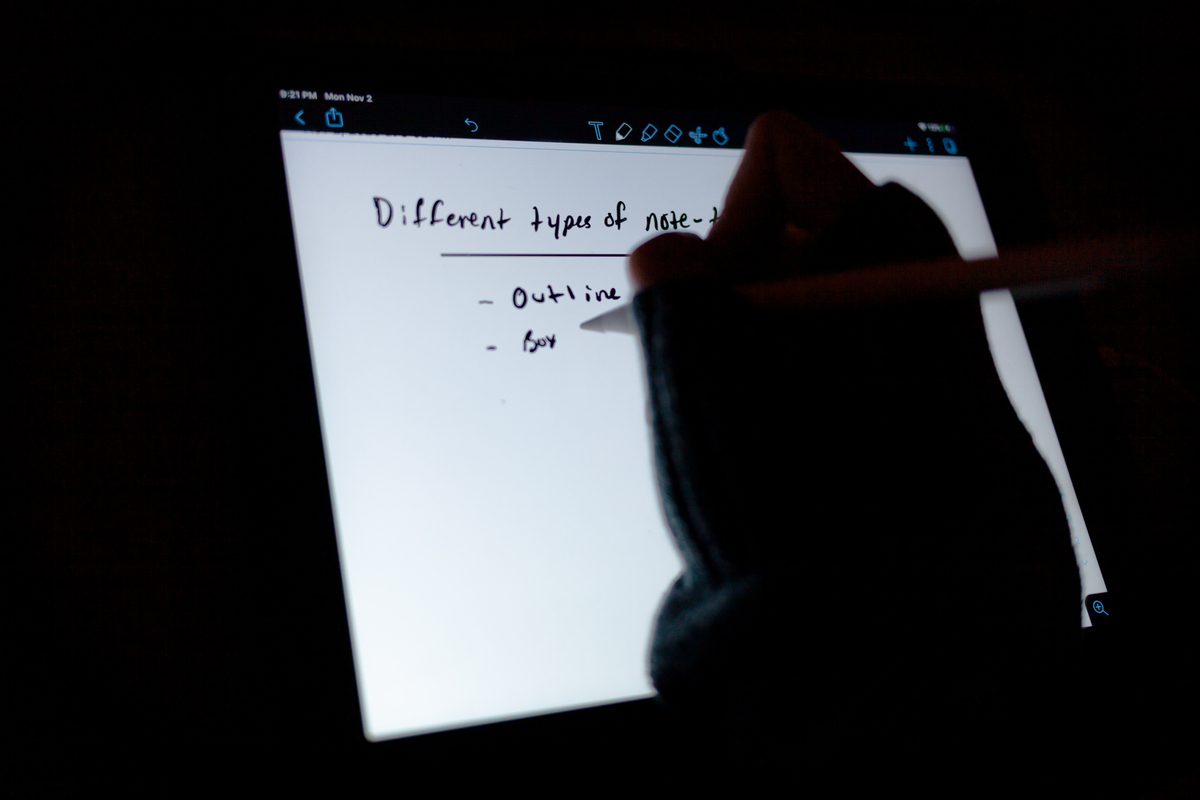
Every prof you’ve ever had has told you that the brain retains notes better if they’re handwritten. Maybe they just hate the sound of keyboards clacking, or maybe there is something to this – but either way, tablets are here to stay and are a safe medium.
– Embrace the storage capabilities of digital note-taking. Take your notes by hand on a tablet device such as an iPad or a Microsoft Surface product with the appropriate digital pen. Paired in combination with Goodnotes 5 (for iOS) or OneNote (for iOS and Android), handwritten notes can be organized into nesting folders and prioritized with colour and marker tools.
– A valuable feature of digital note-taking is the option to cut, paste, resize, and further alter the notes you’ve taken. Endlessly sprawling mind maps are possible with the right perseverance. Just make sure to stay on top of digital minimalism or you may find yourself swamped in digital clutter.
Cornell Note System
Originally developed by Prof. Walter Pauk of Cornell University back in the 1950s, the Cornell note system is considered one of the most efficient ways to take notes. You organize your notes as you write them, by dividing your notepaper into three sections:
1. A 5-7 line long horizontal section at the bottom
2. a vertical column on the left, taking up approximately 30 per cent of your page
3. and the main body of text on the right
You take all your class notes in the main body of the page. Upon revision, add keywords and questions in the left column, and upon further review, add a summary at the bottom.
Quick Tips for Staying Organized
– Start from the ground up and organize your paper in a clear, indexed fashion.
– Colour-code your books.
– Create a highlighting system (yellow for interesting facts, green for definitions, and blue for later review).
– Make sure your digital documents are properly labelled for easy retrieval. Create a coding system (ie: projecta_ii_lastname) so it’s easy to find appropriate files.
– Make frequent use of subfolders to make sure everything is easily identifiable in case you need to share documents with a classmate.
– Compile your class notes in a database system, such as Notion. The powerful word processor allows information to be nested within databases and to-do lists, allowing you to check off your projects in the same program you use to write the project.
– Meticulously comb through your syllabus and note every single due date and topic in your calendar.
– At the beginning of every week place a list of that week’s projects in an easily visible location to make sure they don’t get drowned underneath all the little things that life throws at us.
Growth Mindset
Escape from the restrictive labels of a fixed mindset. Don’t treat yourself as either a good student or a bad student. Sympathize with yourself, recognize your accomplishments, and instill in yourself a growth mindset, whereby you recognize opportunities for growth and the malleability of present moment circumstances. Taking the steps to organize your school notes and refine your productivity is an active step to nurturing a growth mindset.