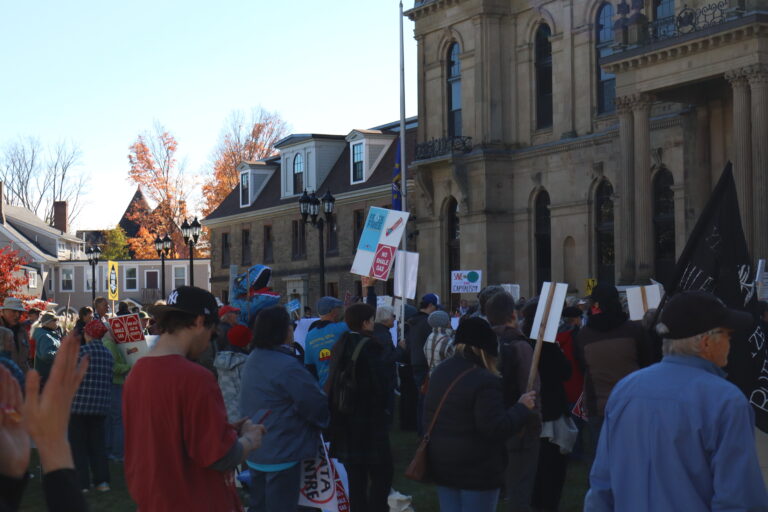




In 2019, UNB is set to hike tuition fees for Arts and Science students by 7.09 per cent; Forestry and Environmental Management by 12.19 per cent; Education, Computer Science and Kinesiology by 17.3 per cent; Business, Nursing, Engineering and Renaissance College by 22.4 per cent and Law by a whopping 50.92 per cent.
In his presentation to the Senate, where over 100 students staged a sit-in to protest, vice-president academic George MacLean said that this is effectively a “reset” to put tuition fees where they would be if there hadn’t been tuition increase caps and funding freezes put in place by the provincial government over the last two decades. This is important, because we need to talk about what has happened to post-secondary education over that time period to understand why students are being asked to pay for UNB’s deficit.
When Paul Martin was finance minister under Prime Minister Jean Chretien, he embarked upon the most brutal austerity program Canada has ever seen. He balanced the federal budget by slashing transfers to provinces beginning in 1995, leading to the provinces having to foot most of the bills on big items like healthcare and education. He then turned around and used subsequent large surpluses to cut taxes, a pattern which was followed by Stephen Harper’s government. In 1997, the federal corporate tax rate was 31 per cent. In now stands at less than half that, at 15 per cent.
This led to big cutbacks in terms of public financing of universities from the provinces, and we’ve seen the drastic rise of tuition fees as a result. What this means is an incremental shifting of costs once borne by the government and paid for by corporations, onto individuals. Instead of progressive taxation, we have flat and regressive user fees. Students are effectively being made to pay for years of corporate tax cuts through crippling student debt. New Brunswick undergraduate students carry the highest average student debt in the country, at $35,200, which is almost 50 per cent higher than the Canadian average of $22,300.
The result is the slow transition of the university away from a public good that is financially accessible to the majority of Canadians into elite institutions where rising tuition fees lock out the underprivileged from getting a higher education. According to the Canadian Association of University Business Officers (CAUBO), operating budgets for universities across Canada since 2001 have more than doubled. This has been mostly financed by rising tuition fees, and 85 per cent of the new expenditure has gone into increased compensation such as salary increases for faculty and administration. This is perfectly illustrated by UNB president Eddy Campbell’s generous compensation package, which is worth more than half-a-million dollars—more than the Prime Minister’s. At the same time, compensation for university support staff has actually declined over the same period, according to CAUBO.
Increasingly, more complex regulation and financial assistance models, as well as decreasing public funding requiring revenue diversification, has led to significant “administrative bloat” at universities due to the overhead costs these bring. According to CAUBO, the cost of university administrations across Canada has doubled since the year 2000. An increasingly competitive university environment where students must be attracted as consumers and sold their education exacerbates these tensions: rising fees lead to decreased enrolment, which accelerates the need to expand administrative bloat to attract more students. Moreover, universities continue to compete for an ever-smaller market as students begin to turn away from the prohibitive costs of a post-secondary education.
In this self-destructive policy context, we’ve seen the acceleration of tuition fee inflation that far outpaces wages and the consumer price index. Tuition fee revenue at Canada’s post-secondary institutions has tripled since 2001. Over that period, wages have remained stagnant and so has public funding for universities.
According to the Canadian Federation of Students, undergraduate tuition fees in New Brunswick have increased by approximately 20 per cent since 2010. “While the recent introduction of the Free Tuition Program & Tuition Relief for the Middle Class initiative does mean an increase in up-front grant assistance available for undergraduate students, the provincial government now spends $20 million less per year on student financial assistance than it did prior to the introduction of these programs,” says their 2018 provincial lobby document.
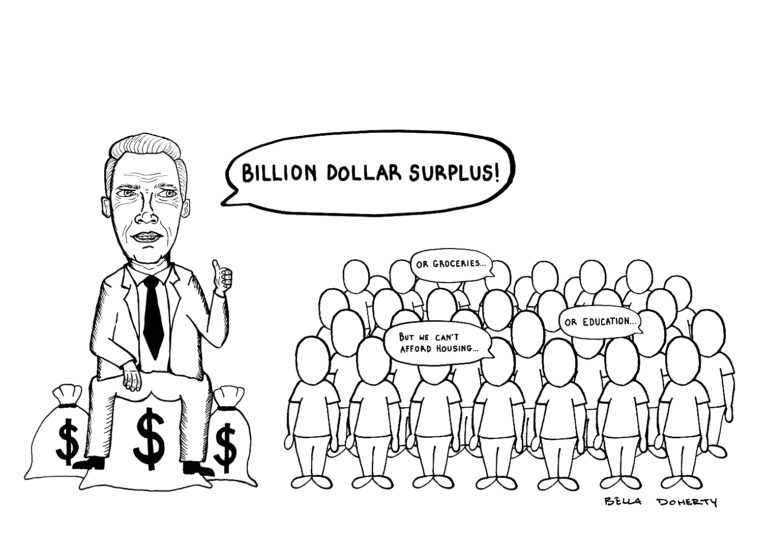
In the new memorandum of understanding with the provincial government, New Brunswick universities other than STU will receive an annual one per cent increase in operational funding for the first three years followed by a two per cent bump for 2020-21. This is less than inflation, which in 2017 was 2.7 per cent, so it represents a cut in real terms of 1.7 per cent this year. This is at the same time that the provincial government continues to lose an estimated $33 million a year thanks to the tax cut they gave to the top 1 per cent of income earners in 2016.
There is alternative to the increasing corporatization of the university. The government needs to simply step in with greater public funding and introduce measures that would improve transparency, accountability and reduce administrative bloat. Tuition hikes aren’t inevitable, we can reign in the runaway corporatization of the university. All it takes is the political will.