



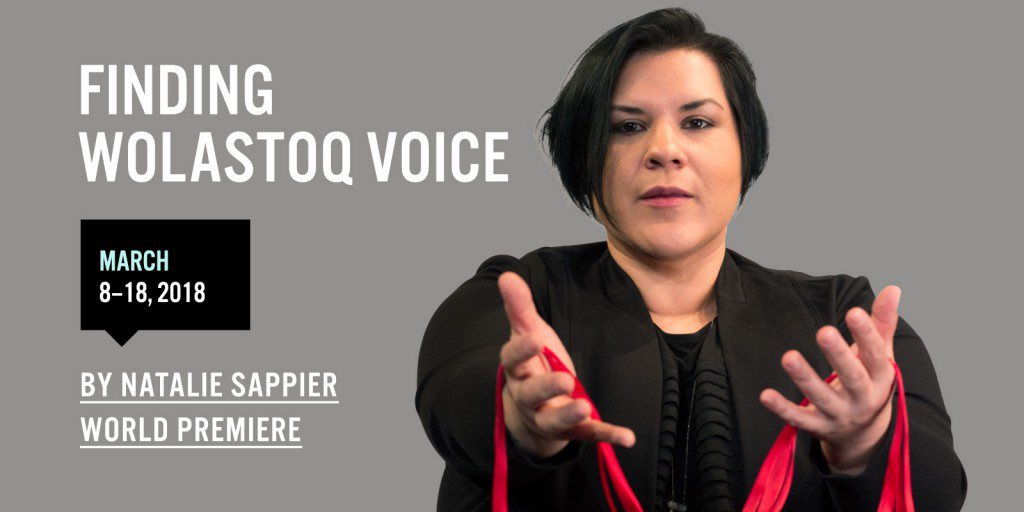
Natalie Sappier—Samaqani Cocahq (meaning The Water Spirit)—is a Wolastoqiyik artist from the Tobique First Nation, and she has taken inspiration from her roots to create this multidisciplinary performance. The performance is somewhat autobiographical, as it is the story of a young Wolastoqiyik woman exploring her own identity and culture. Along with this self-discovery come the voices of the main character’s ancestral past, which guide her experience.
As the audience enters the theatre space, they encounter a wooden-circle divided by four lines of water (presumably representing the four directions of the earth), and this imagery may represent the centering of the Wolastoq as home for Sappier. This structure is encircled by sand, once again honing in on the importance of the Wolastoq, as its waters and sands play a key role in the performance.
The set was designed by Andy Moro, a Euro/Omushkego Cree multidisciplinary artist, who is also the show’s lighting designer. The set he designed for the piece not only centers in the focus of the audience member, but it changes and interacts with the story as it progresses. This change takes form in wooden poles which are placed around the circle, closing in the audience’s gaze even more so, and making the piece seem all the more intimate and personal.
It is in this visually impressive space that Aria Evans, a mixed-race Mi’kmaq dancer based in Toronto, performs. Evans articulates the emotion in Sappier’s writing through movement, in a manner that can be described as no less than stunning and powerful. Throughout the performance, Evans also interacts with the water and sand on stage, highlighting the importance of the Wolastoq to this piece.
There is a delightful use of audio recordings in this show, all coordinated by sound designer and music director Michael Doherty, based in both Atlantic Canada and Toronto. These recordings include the voice of Imelda Perley, the Elder-in-Residence at the University of New Brunswick; the voice of Sappier herself recounting her writing to the audience and music composed by Sappier, other than the Wolastoq Song, composed by Gwen Bear -Sagatay. These clips represent the voices of Indigenous ancestors, and the influence of Indigenous culture and heritage on the piece as a whole.
All of these artists work in coordination with Thomas Morgan-Jones, the artistic director at Theatre New Brunswick and the director of this piece. Throughout all of this artistic co-operation, what ultimately comes out is a revival of Indigenous tradition and the birth
of a voice for the Wolastoq that has been suppressed for centuries, and in some manner, forgotten.
Finding Wolastoq Voice may be best described as a coming-of-age story, as the young Wolastoquiyik woman of the story truly does age and discover her identity as an Indigenous person. Yet, there is a meta-context to consider with this piece of Indigenous art. Just as the young woman discovers herself, so Sappier reveals her Wolastoquiyik identity, and the Indigenous voice across the land that is now Canada.
Within our current political atmosphere, conversations around Truth and Reconciliation are receiving more attention than ever before. Sappier’s piece marks a time period in which more Indigenous voices will be heard and Indigenous stories shared, just as a collective Indigenous story is shared through Finding Wolastoq Voice.
From March 8 to the 18 Natalie Sappier’s Finding Wolastoq Voice was showcased through Theatre New Brunswick (TNB) at the theatre company’s Open Space Theatre. The show is touring throughout New Brunswick from March 21 to April 6, and showtimes and locations can be found on TNB’s website.