



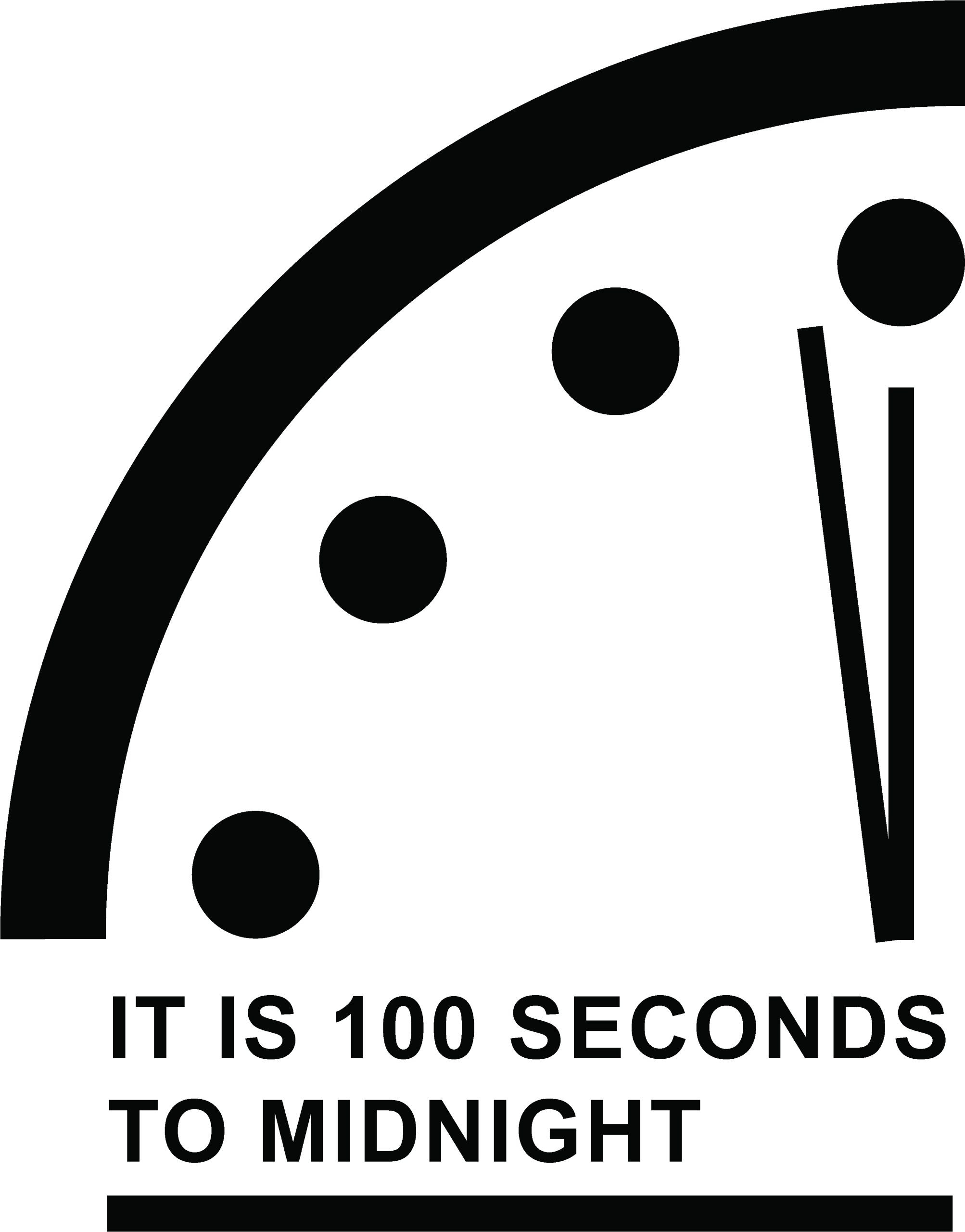
As of January 23rd, we are only 100 seconds away from dying. That sounds a little bit like clickbait, but it’s true– at least, according to the Doomsday Clock.
The Doomsday clock was created in 1945 after the development of nuclear weapons. It’s a theoretical clock whose hands move closer or further away from “midnight,” which represents Doomsday, or the so-called end of the world. The clock is managed by the Bulletin of the Atomic Scientists. The hands of the Doomsday clock move based on careful research and analysis conducted by the, “Bulletin’s Science and Security Board in consultation with its Board of Sponsors, which includes 13 Nobel laureates,” according to the Bulletin’s 2020 Doomsday Report by John Mecklin. This clock has been the measure of the status of the world for nearly 75 years, and never has it been this close to midnight.
Previously, the closest the clock had been to midnight was two minutes. It was two minutes to midnight in 1953, during the cold war. The clock was moved to two minutes to midnight once again in 2017 due to issues facing humanity due to climate change, and also the buildup of nuclear weapons programs and the devolution of international treaties. Never has the clock been so close- 1.67 minutes to midnight.
History lesson over. Now that we all have the background information, I can delve into the issue. How does it feel? How does it feel to be barely 20 years old and know that the world is closer to destroying itself than it has been in the past 75 years? I don’t know. It makes the world feel so small and delicate– as though all the issues (climate change, politics, etc.) that made them move the hands of the clock are small enough to fit in my palm. My world feels delicate, and it makes me feel delicate too.
But I mean, it’s not as if when the imaginary hands get to midnight, everything will just blink out of existence. Right? Probably. The problem with the apocalypse is that even though I feel like I can see it coming, I don’t know how it’s going to kill me. The whole concept of a Doomsday almost feels like a ploy from a cheap B-horror movie.
I’ve had too many conversations lately about the Doomsday Clock. I’ve had so many conversations about life and death, and different historical examples of how people have reacted to the belief that everyone was going to die (the plague, the world wars, famine). What am I supposed to say about the fact that we might die?
It would be different, I think, if I couldn’t see everything that was going on. Almost easier to ignore the whole issue, if say I had never seen a forest fire, or an animal that had starved to death, or the aftermath of a bombing. But I have seen those things, either through my own eyes, or someone’s camera lens, and there is no denying, no matter how hard some people try, there is no denying the fact that the planet is dying and that we’re all killing it.
I’ve spent a lot of time writing about hope, because I really believe in that quotation from Inherit the Wind, that, “it is the duty of a newspaper to comfort the afflicted and afflict the comfortable.” I’ve worked at trying to be positive and trying to think of ways to bring hope and light. But it’s 100 seconds to midnight, and it’s getting dark outside.