



Imelda Perley grew up completely immersed in the Wolastoqey language on Tobique First Nation. But when day schools opened and nuns came to the community, her mother tongue was banned.
Perley’s family developed tricks to continue speaking their language.
“When a priest or Indian agent would come up on our sidewalk, the dog would actually bark and we’d switch from our language to English so that when they came to our door, we’d be pretending we’d been speaking English,” she said.
Perley, now 70, is a leader in the fight for Indigenous language survival after decades of English-only speaking policies have reversed the flow in communities across New Brunswick.
The United Nations declared 2019 the International Year of Indigenous Languages, and in February the federal Liberal government passed legislation to protect Indigenous languages. The new law creates the Office of the Commissioner of Indigenous Languages, aimed to protect and promote languages.

This news of financial support comes as the number of speakers of New Brunswick’s Indigenous languages is rapidly dwindling.
The last census reported the Wolastoqey language disappearing at an alarming rate. Statistics Canada found a 57 per cent decline over 15 years in the number of people with Maliseet or Wolastoqey as their mother tongue.
Many of these people no longer speak the language or are no longer fluent. Linguists consider the number of fluent speakers to be a critical sign of the health of a language.
Perley belongs to only a few dozen fluent, native speakers of Wolastoqey, who through resiliency have carried their language forward.

New Brunswick has been home to the Mi’kmaq and the Wolastoqiyik for thousands of years. The languages of both peoples are part of the Eastern Algonquian language tree.
The Wolastoqiyik have long lived along the Wolastoq River Valley, which is now known as the St. John River in New Brunswick and the state of Maine. Their name means people of the beautiful and bountiful river. Historically, European settlers referred to them as Maliseet, a Mi’kmaq word that translates to “slow speaker.”
Today there are six Wolastoqey communities in New Brunswick, including three in the Fredericton area: Kingsclear, Oromocto and Saint Mary’s. In the 2016 census, around 7,600 people identified as having Wolastoqiyik ancestry.
The traditional territory of the Mi’kmaq includes the coastal areas of New Brunswick east of the St. John River. There are about a dozen Mi’kmaq communities scattered throughout the coastal areas of the province.
Despite the challenges of assimilation, Mi’kmaq has endured more than Wolastoqey since it has a strong presence in other Atlantic Canadian provinces. A 1999 report by the Nova Scotia Mi’kmaq Language Centre of Excellence found just less than 3,000 fluent speakers.
Language education initiatives lack funding
The percentage of fluent speakers of Indigenous languages is low in New Brunswick, and language carriers are growing older and passing away.
Perley said being one of a few speakers of a language is sad and lonely.
“For many years, when I’d go visit my elders, they’d be so happy because we would speak in the language,” she said.
Perley is the elder-in-residence at the University of New Brunswick. She teaches language and native studies courses at UNB and St. Thomas University.
She’s also the founder of the Wolastoq Language and Culture Centres at Tobique and St. Mary’s First Nations, has taught at Fredericton High School and leads community-based courses and workshops.
“We want to make sure we encourage future speakers by continuing to be those medicine people, anyone that’s willing to carry our language with us,” Perley said.
Perley said it’s extremely challenging for youth to learn because they have to decide between studying their Indigenous language or French in school.
“The choice is, I want a job, but I also want my language,” she said. “It’s almost as if they’ve been torn apart in how they want to be.”

Perley said Indigenous language courses often lack textbooks and other necessary resources because they don’t receive the same funding as English and French.
In 2017, the New Brunswick Department of Education rolled out a ten-year plan designed to meet calls to action from the federal Truth and Reconciliation Commission. Advanced Mi’kmaq and Wolastoqey language courses are now available for students of First Nations ancestry at New Brunswick public schools.
The curriculum includes a new Native studies course and Indigenous content in social studies and history courses.
Perley said those changes don’t go far enough.
“Our schools, even in our communities, yes they teach a language course, but they teach it not in an immersion way,” Perley said. “They teach it where we just point at things and name them. They’re objectifying.”
The new Indigenous Language Commissioner’s Office, established by the federal government, will plan activities to restore and maintain fluency, create educational materials and preserve permanent records. Perley said she is already in talks with officials to obtain funding for Wolastoqey-related initiatives.

Through the Mi’kmaq-Wolastoqey Centre, Perley and her husband David, the centre’s director, created the Wolastoqey Latuwewakon language app last year. The app aims to teach people how to use words and phrases related to the Wolastoqey people and their culture.
Users can hear words related to holidays, animals, medicines, seasons, clothing, weather, games and ceremonies. The phrases are read by Perley.
They can even be used in everyday life, such as talking about baseball or playing a game of pool. A second app is currently in development.
‘There is hope’
Nancy Harn, a Mi’kmaq woman from Eel River Bar First Nation, has been learning her language through courses at the University of New Brunswick, with the goal of passing it on to her children and grandchildren.
“It’s a part of my culture and my identity,” she said.
Harn would hear her father speak Mi’kmaq with elders in the community growing up. But he never spoke the language to her at home.
“It was just a connection that I craved so badly at that point in time,” Harn said. “It felt like a part of me was missing.”
Ramona Nicholas is a Wolastoqey woman from Tobique First Nation pursuing a doctorate degree at UNB.
“I came from a generation where speaking the language was not appropriate and frowned upon,” she said.

Nicholas said she would only hear her mother speak the language when her grandmother was around. Like Harn, she hopes to raise her grandchildren to be speakers.
Jennifer Leblanc is the coordinator of Wabanaki Language Revival at UNB’s Mi’kmaq-Wolastoqey Centre. She was born in Manitoba and has Mi’kmaq, Scottish and Acadian roots.
“There is hope,” LeBlanc said. “I see just the excitement of youth and the understanding of the importance of language.”
Perley and LeBlanc believe anyone interested in learning should have the opportunity. This belief extends to non-Indigenous students.

Jen Rowett is one such student. Currently a doctorate student in the UNB Faculty of Education, she’s learning Wolastoqey. The university’s courses are growing in enrollment and are often at maximum capacity.
“As a non-Indigenous individual entering those spaces there’s just a sense of welcoming from both the instructors and fellow students, which I really appreciate because I feel it’s such a gift, it is part of the culture,” Rowett said.
Indigenous language is also being passed along through traditional practices, such as sweat lodge ceremonies. Chris Brooks, a Wolastoqey elder, conducts sweat lodge ceremonies at his home on the edge of St. Mary’s First Nation
While most of the instructions and conversations are in English, the prayers and songs sung in the language help keep it alive and carry it on.

Language leaders are working to engage the next generation and develop an understanding of the importance of language in preserving culture and identity. They are also trying to develop materials and incorporate more language into everyday life.
Perley said she would like to see more Wolastoqey language displayed throughout the Fredericton area.
One of her favourite actions to preserve the language is to give spirit names to babies. She has given over 100.
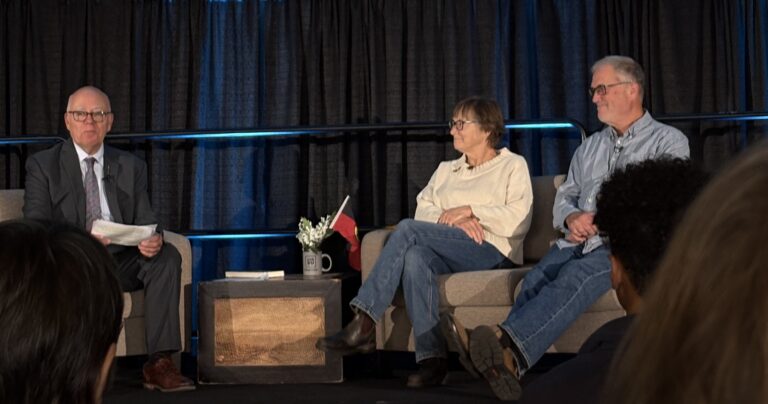
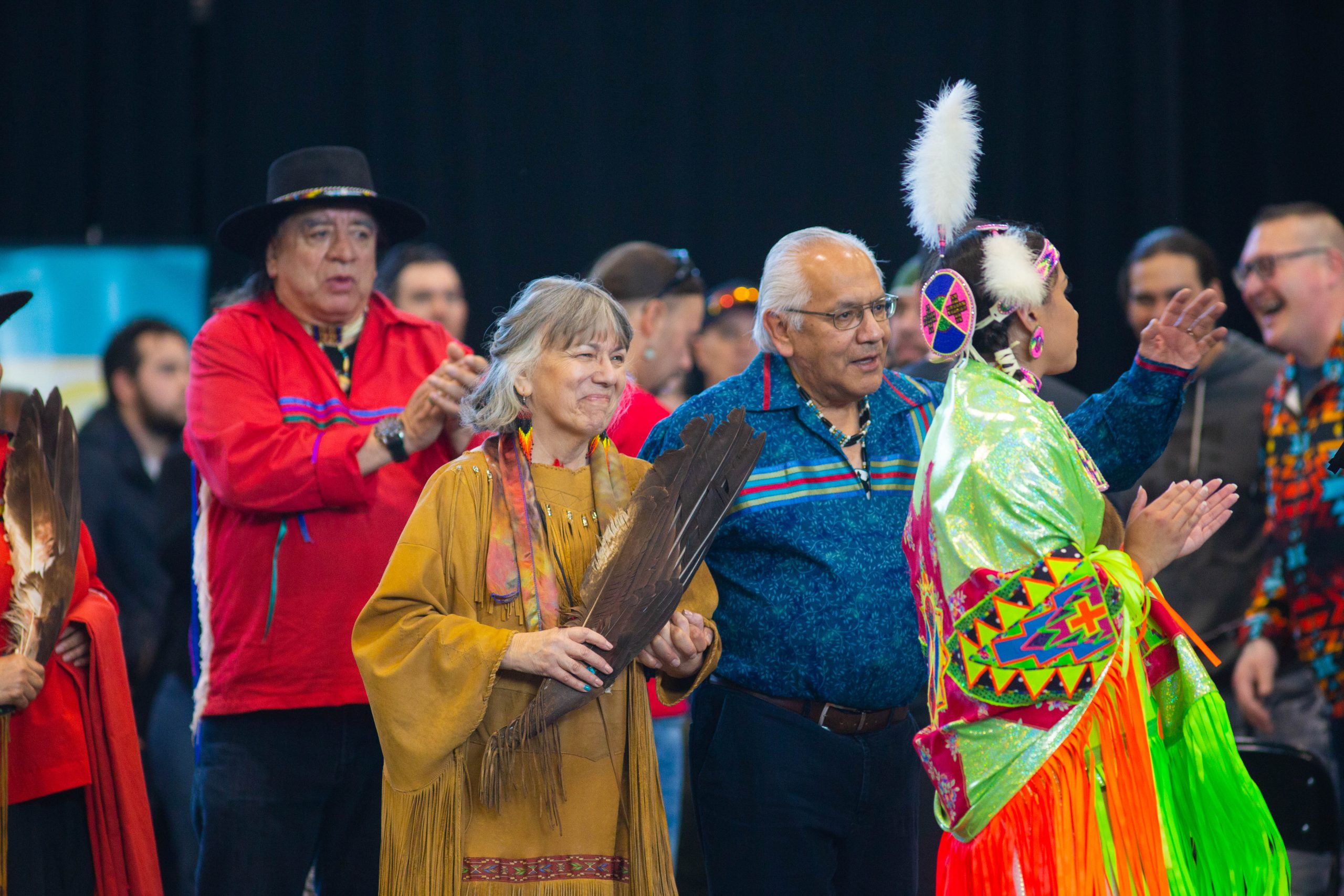
When an Indigenous language conference from April 4-7 on the University of New Brunswick campus brought together hundreds of people, the event began with a grand entry of spirit names.
For Imelda Perley, this language gathering was one of her last projects after a long career teaching language and native studies courses. Along with her husband David, she will be retiring at the end of April.
But she hopes the push to save languages, especially Wolastoqey, will continue.
“It’s never too late,” Perley said. “If we use it, and speak it and bring it back to life, it can survive.”