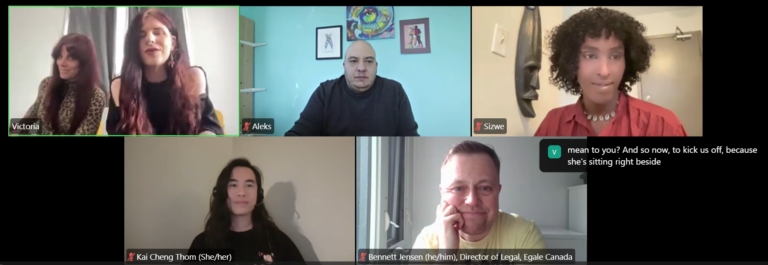




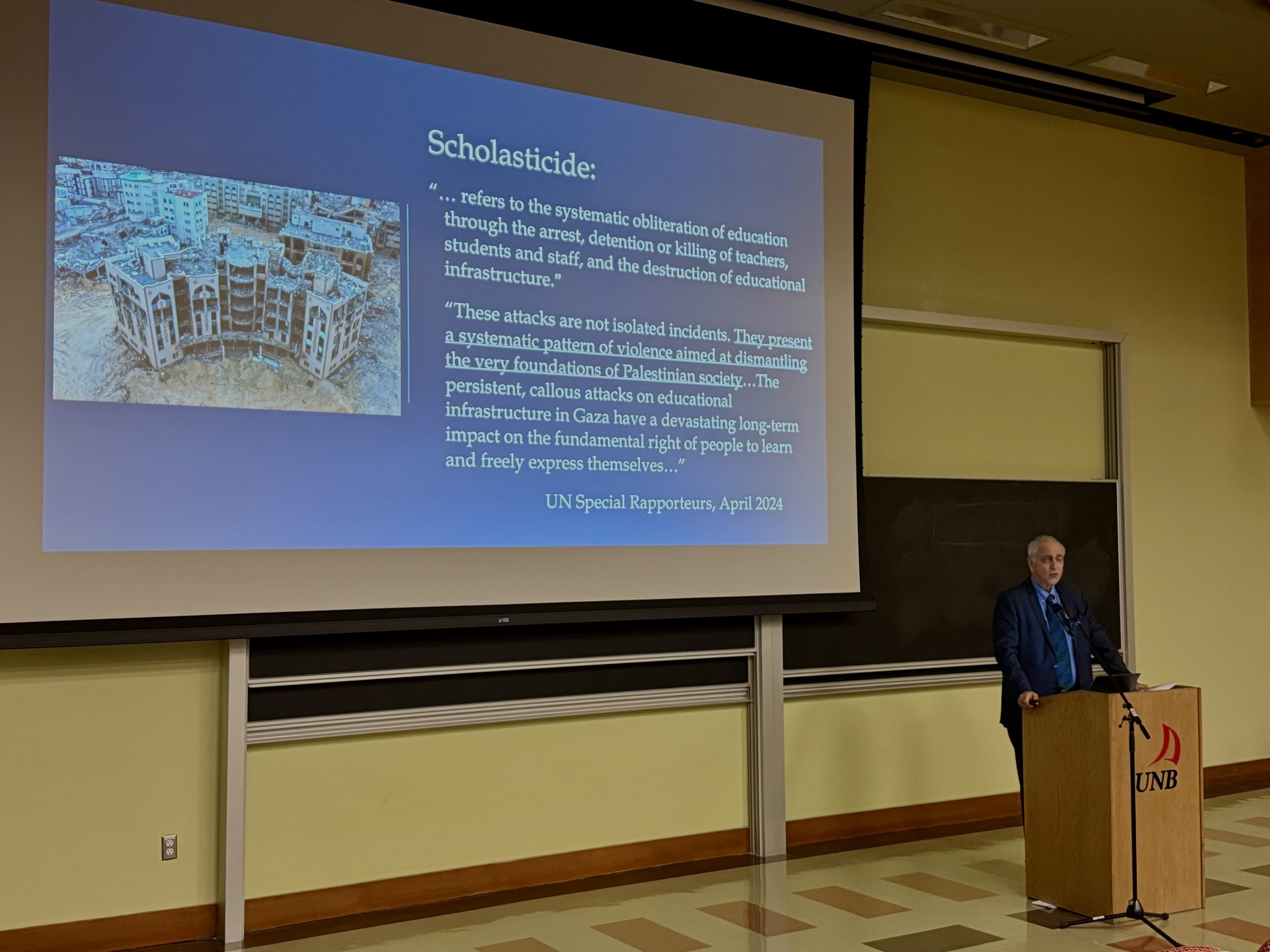
On Wednesday, October 1, 2025, Professor Michael Lynk, former UN Special Rapporteur on the Occupied Palestinian Territories, gave a talk in Tilley 102 about Academic Freedom and the Palestine Exception.
According to the UN Commission of Inquiry, as part of the genocide committed by Israel, Gaza is enduring a “scholasticide.” Professor Lynk defined scholasticide using the current UN Special Rapporteurs explanation:
“[Scholasticide is] the systematic obliteration of education through the arrest, detention or killing of teachers, students, and staff, and the destruction of education infrastructure”.
Dr. Jeff Brown, an associate professor in the Department of Historical Studies at UNB Fredericton and longtime activist for Palestinian human rights, articulated his position on the use of scholasticide against the Palestinian people:
“Racism requires that people be dehumanized … In the Palestinian diaspora, people are highly educated, so it’s almost as if a part of the genocide against Palestine has to include the destruction of their capacity to learn … [it’s dehumanizing] to imagine them as ignorant …. Israel is propagating a genocide in order to create barbaric people, in order to deprive people of the conditions and circumstances of life that allow them to have a decent society”.
Dr. Brown then explained that scholasticide is only one aspect of the wider genocide that UNB students must focus on:
“Every aspect of this genocide should be on the minds of every human being…our society, Canada and the United States, has supported [Palestinians’] dehumanization, their deprivation, their murder–mass murder–the scholasticide…all of that could stop tomorrow, if the world stops supporting Israel.”
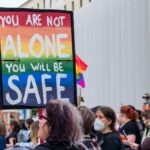
In Professor Lynk’s talk, he covered the active suppression of Pro-Palestine movements on university campuses across the United States and Canada. In the U.S., over sixty universities were targeted due to pro-Palestine student protests. Some universities had research funding suspended until they complied with federal demands to shut down demonstrations.
Professor Lynk connected this repression to the Canadian context where university administrators disproportionately persecuted student encampments and protests for Palestine . The University of Alberta saw some of the harshest treatment of student encampments, seeing the first deployment of police force to devastate peacefully protesting student activists.
On the other hand, the University of Windsor began negotiations with activists that concluded with university administrators terminating all institutional ties with Israel until Palestinians achieve self-determination. This agreement was followed by a smear campaign and accusations that the university being antisemetic.
Lastly, at the University of Toronto, an Ontario judge rejected all claims of hate speech and antisemitism; however, the judge granted the disbandment of the encampments based on the fact that the University of Toronto is private property.
Dr. Brown described the pro-Palestine protest on the UNB campus and how the atmosphere of repression affects them:
“I have nothing but praise for the efforts that students have made on behalf of Palestine, but it is understandably difficult to sustain those efforts”.
It is important to note that a substantial number of participants in the encampments in both the US and Canada were Jewish students.
Professor Lynk clarified that students activists do not have the same academic freedoms that faculty members are afforded, but as part of the Canadian Charter of Rights, they are entitled to expressive freedoms.
The Canadian Association of University Teachers’ Statement on Freedom of Expression and Peaceful Protest on Campus warned the academic community that:
“Universities and colleges administrations fail in their duty to uphold the foundational purposes of our institutions when they limit or preempt peaceful protests and counterprotests. …they are silencing expression and censoring speech”.
Regarding students’ freedom of expression, UNB’s President’s Office notes that:
“It is not the role of UNB to stifle debate or to contribute to the creation of an atmosphere that discourages the free expression of ideas and viewpoints. The institution is not political, but that in no way impedes the expression of its students and faculty – it encourages an environment where this expression can flourish.”
For students who want to utilize that “environment where expression can flourish,” Dr. Brown recommended students sign petitions, lobby the administration, protest, write, argue, organize teachings and debates, and push for the government to severely condemn the Israeli state through sanctions.