



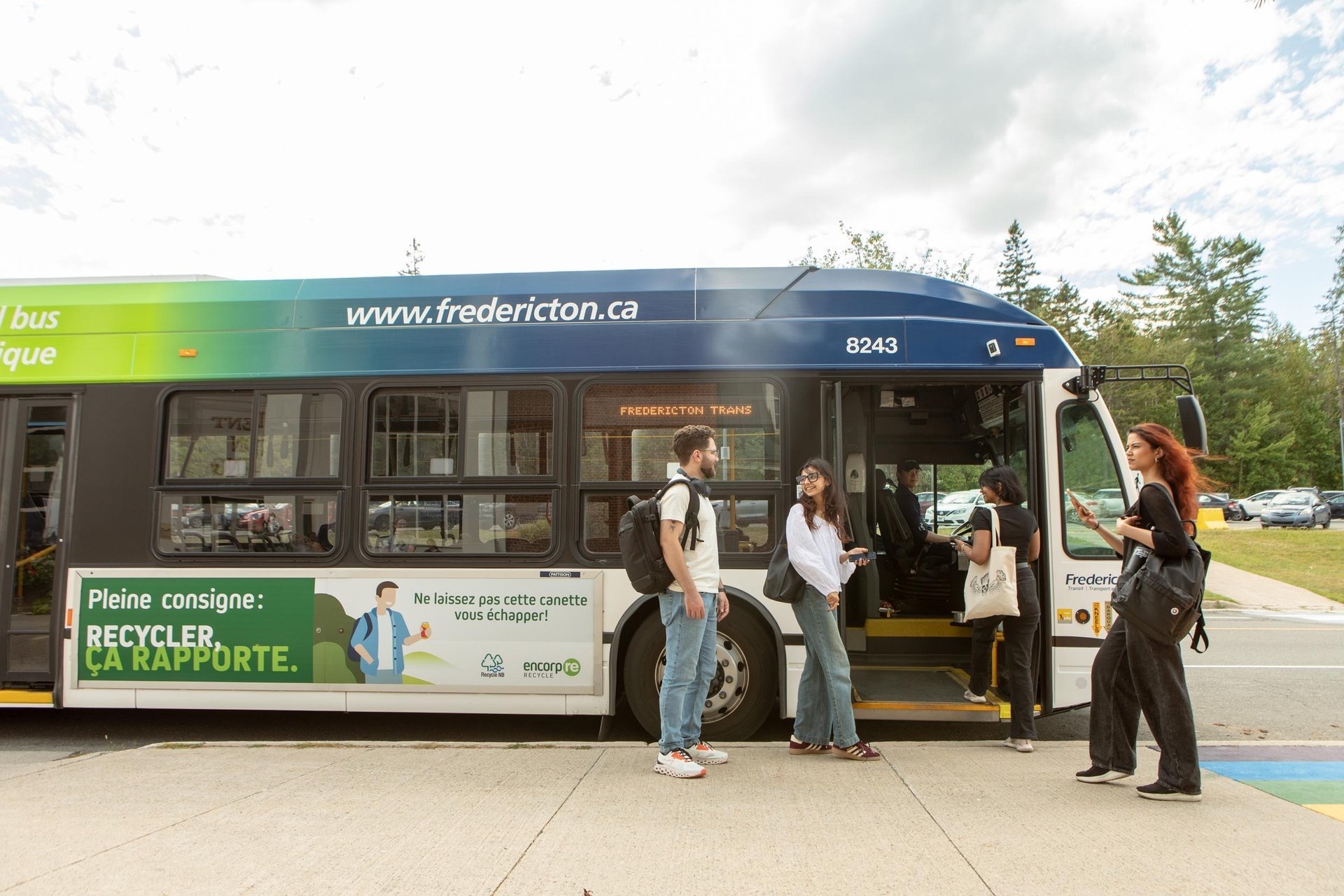
Cover Photo Credit: Shasta Stairs, Communication Manager, City of Fredericton
On October 15, 2025, the City of Fredericton announced that it will add six new hybrid diesel-electric buses to its Fredericton Transit fleet—an $8.4 million dollar investment aimed at cutting consumption and advancing the City’s climate-action targets. With the hybrid buses now active the milestone marks a major tangible step toward Fredericton Transit’s fleet electrification.
Delivered this fall from New Flyer Industries, the buses replace older diesel models that had logged more than a decade of service. According to the City of Fredericton’s October 15 media release, these buses will help the city move toward its goal of reducing greenhouse-gas emissions 50 percent below 2004 levels by 2030 and achieving net-zero emissions by 2050.
Backed in part by $141,712 from the Government of Canada’s Zero Emission Transit Fund (ZETF), and $35,428 from the City, the project underscores the importance of collaboration between federal and municipal governments in advancing climate-conscious infrastructure.
Fredericton Mayor Kate Rogers reported:
“Fredericton is one of the fastest growing cities in the country, and the support the City is receiving through the Zero Emission Transit Fund will allow Fredericton Transit to grow alongside our vibrant community. This funding will enhance the climate resiliency of the city’s transit offerings, ensuring Fredericton remains connected by providing a consistent affordable friendly mode of transportation for residents.”
The Honourable Gregor Robertson, Minister of Housing and Infrastructure and Pacific Economic Development Canada, provided the federal perspective:
“This planning project is the key to successfully integrating zero emissions transit in Fredericton. The Government of Canada is proud to partner with communities looking to lower their [greenhouse gas] emissions, to ensure a cleaner and healthier future for generations to come.”
While each bus costs approximately $1.4 million dollars, the cost will be financed through the Municipal Capital Borrowing Board, with payments spread over the next ten years.
Fredericton Transit’s 2023 annual report listed 28 low-floor buses in active service. These buses reported over 1.3 million passenger trips that year alone. Although the City of Fredericton did not announce their fleet total in 2024, the October 15 release confirmed 31 buses are currently active, which suggests a replacement of older units rather than an expansion of capacity.
Hybrid diesel-electric technology allows the new buses to capture energy and store it in onboard batteries, reducing fuel consumption by roughly 25 percent compared to traditional diesel buses. City officials describe the move as a “bridge step” toward the future electrification—a critical step in the longer term plan of the Canadian Urban Transit Research and Innovation Consortium (CUTRIC).
Josipa Petrunic, the president and CEO of CUTRIC, expressed their support:
“Transitioning Fredericton’s transit fleet to zero emissions requires careful planning to ensure the city invests in the right technologies at the right time. CUTRIC is proud to support Fredericton in developing a roadmap that reduces emissions and improves greener transit options for residents.”
The University of New Brunswick’s Sustainability team encouraged students to use public transportation as a part of broader commitments to reduce carbon emissions.
The UNB Sustainable Transport Initiative noted:
“There are lots of ways to travel … [with] … some more sustainable than others.”
The new hybrid buses may start Fredericton students on this path, though the initiative is up and running elsewhere in Atlantic Canada as well.
In Halifax, Nova Scotia, 60 battery-electric buses have already joined the fleet as a part of the city’s “Zero Emission Bus Project,” which aims to deploy 200 zero-emission buses by 2028.
Meanwhile, Prince Edward Island’s capital region, Charlottetown, continues to invest in the infrastructure needed to support full fleet electrification. Their 2025 Community Energy Plan outlines ongoing work on charging stations and grid upgrades as moves towards a fully electrified fleet by 2030.
In St. John’s, Newfoundland and Labrador, Metrobus Transit has also begun the shift toward electrification through a multi-phase zero-emission fleet strategy, supported by federal infrastructure funding announced in 2023 (Government of Canada).
Across Atlantic Canada, progress looks different in every capital city:
Halifax is leading with large-scale electrification, Charlottetown is building the infrastructure to follow, and St. John’s is beginning its own multi-phase conversion. Fredericton’s approach is smaller, more measured, and focused on incremental upgrades rather than large-scale sweeping change.