



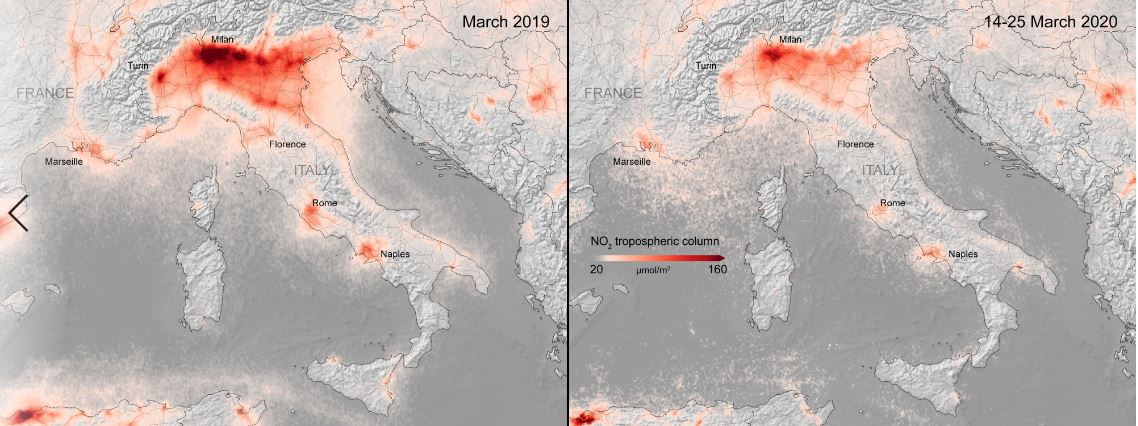
The COVID-19 pandemic we are living through right now has stopped the world for a while now, and this has had some interesting effects on the environment and its air pollution levels. Air pollution has been linked to 4.2 million deaths, according to the World Health Organization. The major sources of air pollution include vehicles, power generation, building heating systems, agriculture/waste incineration, and industry. This is why lockdowns have had a considerable effect on the levels of nitrogen dioxide.
Even though the pandemic has had negative effects on the economy, health systems, security, and many other aspects, people can also benefit from the secondary effects of the lockdowns.
Without millions of vehicles on the roads, and the closure of industries, air pollution levels have somewhat decreased. An article at ‘Science Alert’ said that for air pollution levels to drop, anthropogenic emissions had to be suddenly stopped, and this situation has made the world stop.
The anthropogenic emissions have not stopped completely, but no use of vehicles in certain countries and the closure of industries has certainly made an impact. Vehicles are strong emitters of nitrogen dioxide.
In China, air pollution levels are considerably high in some of its most populated cities (e.g Beijing). China is one significant emitter of greenhouse gases and due to the pandemic, the country had to basically shut down its economy. China has a population of 1.386 billion (2017), and during the pandemic, the country quarantined approximately 46 million people, according to Business Insider.
China has been working on reducing its air pollution levels, and since last year they saw a reduction in levels of toxic particulate matter of 2.5 micrometres (PM2.5). PM2.5 deteriorates human health as they enter the lungs and cause disease. The lockdown has further improved its air quality in certain areas.
China’s Ministry of Ecology and Environment said the average number of days with good quality air increased in February, according to CNN.
The European Space Agency (ESA) has made public satellite data that proves air pollution has decreased in Italy, France, and Spain. According to the ESA, nitrogen dioxide concentrations have decreased around the cities of Milan, Paris, and Madrid. This reduction could be linked to the pandemic, as these cities have been amongst the most affected and have had to quarantine.
The satellite data showing a reduction from nitrogen dioxide are from March 14 to 25 of 2020 and are compared to the monthly average concentrations from 2019, stated the ESA.