



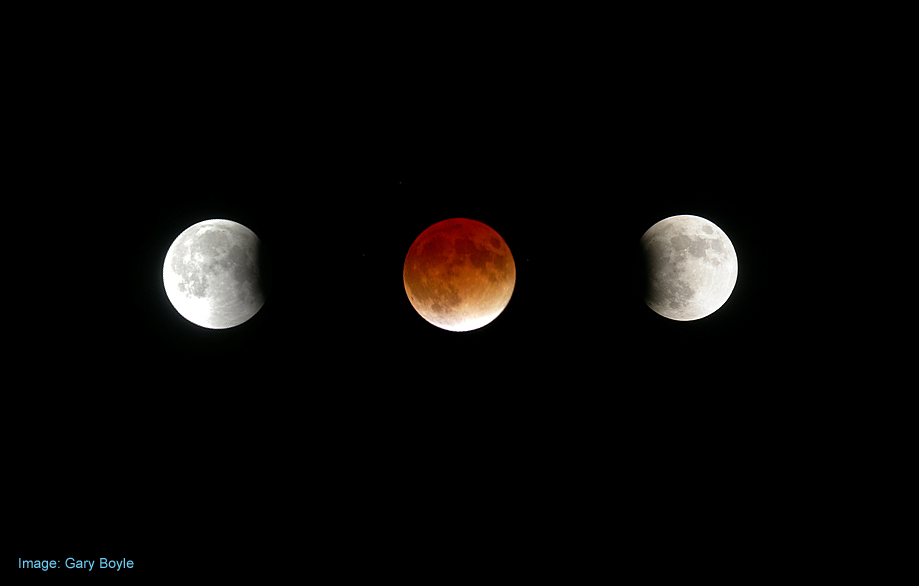
Cover Photo Credit: Gary Boyle
On March 3, a lunar eclipse unfolded in the early hours of the morning, gradually dyeing the pale Moon darker shades of orange. According to Time and Date, the eclipse unfolded with penumbral beginning at 2:44 AM CST (4:44 AM AST) and totality at 5:04 AM CST (7:04 AM AST).
Lunar eclipses occur when Earth is positioned between the Moon and the Sun, causing its shadow to fall across the moon’s surface, giving it its characteristic red tint over the course of a few hours. It is a wonderful event, safe to watch and enjoy, unlike solar eclipses.
Beyond the science of it, students around campus enjoy these experiences socially, gathering amongst friends to sightsee while sharing time with their community.
Ana Hode, a third year geomatics student at UNB, shared the importance of an eclipse for her:
“It’s not dramatic like a solar eclipse, but there’s something cool about knowing many other people are also outside looking up at the same time, even in other places … During last year’s eclipse, a few of us went to my friend’s apartment because she has a balcony that faces the river … We had blankets because it was really cold, and we kept looking outside to check if the moon was different.”
Hode also recounted her experience watching this March’s eclipse:
“I didn’t want to wake up so early because it was really cold, but watching eclipses has become a habit … I had to walk a lot around campus to find the moon. It was pretty, as always. Even though I was by myself in the cold, I felt amazed and oddly comforted. I’m glad I woke up.”
Gary Boyle, an astronomy educator known as “The Backyard Astronomer,” noted that the next solar eclipse will occur on August 12, stretching from Greenland through Spain, during which the Moon will cover the Sun for several minutes depending on the viewer’s location. Another lunar eclipse will follow on the night of August 27 into the morning of August 28, when Earth’s shadow will immerse approximately 96% of the Moon. Meanwhile, Boyle encourages viewers to look for the planet Jupiter, which will be high in the sky, along with Orion the Hunter and other shiny winter constellations.
So, if you’re hoping to start a new tradition this summer, gather some friends and family for the upcoming eclipses.